
Consumer Electronics Biometric Market Size and Forecast 2025 to 2034
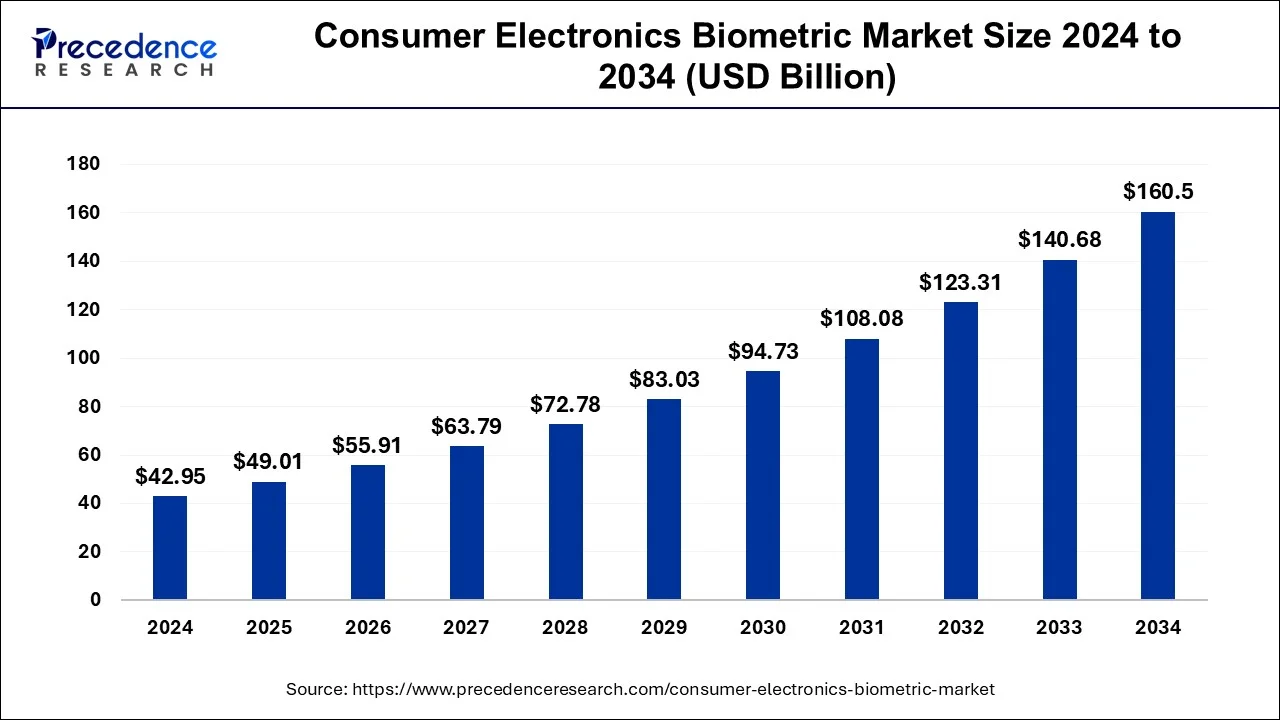
The global consumer electronics biometric market is poised for remarkable growth, measured at approximately USD 42.95 billion in 2024. Projections indicate a leap toward USD 160.50 billion by 2034, reflecting a substantial compound annual growth rate (CAGR) of 14.09% from 2025 to 2034. This robust expansion is primarily fueled by escalating concerns regarding cyber fraud and data breaches, highlighting the critical need for enhanced security measures.
Consumer Electronics Biometric Market Key Takeaways
- The market’s valuation at USD 42.95 billion in 2024 marks a significant milestone.
- A forecasted increase to USD 160.50 billion by 2034 underscores the market’s upward trajectory.
- Expanding at a CAGR of 14.09%, the market demonstrates strong growth potential.
- North America holds a commanding market share of 39%, leading the global landscape.
- Europe is anticipated to experience significant growth in the near future.
- The fingerprint recognition segment emerged as the frontrunner in market contribution in 2024.
- Anticipated growth in iris recognition technology is notable during the projected period.
- Single-factor authentication dominated the security level segment in 2024.
- Exceptional growth in multi-factor authentication is expected moving forward.
- Smartphones generated the largest application share, accounting for 46% in 2024.
- The wearables segment is projected for significant CAGR in the upcoming years.
- The consumer segment led the market with a 61% share in 2024.
- The business segment is expected to see substantial expansion during the forecast period.
How Can AI Impact the Consumer Electronics Biometric Market?
Artificial intelligence (AI) is a game-changer in the evolution of the consumer electronics biometric market. By integrating cutting-edge features, AI enhances various biometric technologies. For instance, in facial recognition systems, AI can significantly lower the false acceptance ratio. In fingerprint recognition, AI addresses challenges related to recognizing damaged fingerprints or overcoming skin condition variations. The incorporation of AI not only boosts performance but also elevates accuracy across the board.
- In November 2024, Alcatraz AI introduced an insightful eBook aimed at data centers, detailing how biometrics can enhance security by replacing traditional methods, thus supporting the growth of the data center market.
U.S. Consumer Electronics Biometric Market Size and Growth 2025 to 2034
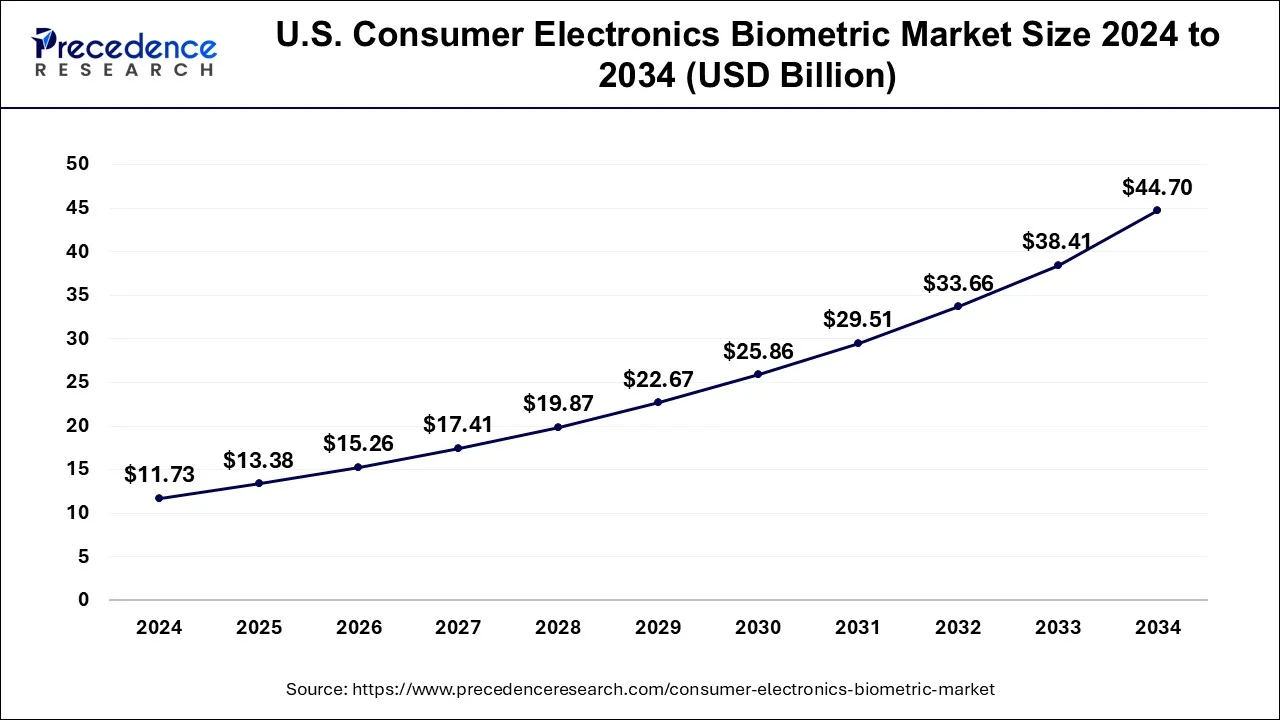
In the United States, the consumer electronics biometric market was valued at USD 11.73 billion in 2024 and is projected to rise to approximately USD 44.70 billion by 2034, representing a CAGR of 14.31%. North America, particularly the U.S., is driving growth through increased industrialization and the rapid adoption of advanced technology. Rising disposable incomes amongst consumers further support this trend, as individuals increasingly seek innovative consumer electronics.
According to Visa, approximately two-thirds of individuals prefer biometrics over traditional passwords, seeking faster, more convenient access. A telling McKinsey statistic indicates a potential 90% cost reduction through digital ID-enabled onboarding processes. These trends confirm a growing consumer appetite for both security and convenience in the digital landscape.
Europe is expected to exhibit substantial growth in the consumer electronics biometric market as well, driven by heightened demand for technological gadgets. Industrial advancements across various sectors, including healthcare and finance, are propelling the need for biometric authentication.
- The Digital Decade of Europe initiative aims for 80% of EU citizens to utilize digital identities by 2030, spotlighting the urgency for biometric solutions.
Market Overview
Biometrics, designed to authenticate individuals swiftly and efficiently, leverage unique biological traits such as fingerprints, facial features, or voice patterns. The increasing permeation of biometric technology across different sectors—ranging from healthcare to finance—is evidently driving market growth.
Consumer Electronics Biometric Market Growth Factors
- Rising Popularity of Electronic Gadgets: Increased disposable income and economic stability have led to a growing consumer inclination towards advanced electronic devices, bolstering demand within the biometric market.
- Surge in Industrialization: Across banking, healthcare, and automotive sectors, enhanced security measures through biometric authentication are gaining traction.
- Advancements in Smart Gadgets: A continuous influx of investment and innovation in smart technologies from leading tech companies is accelerating market growth.
Market Scope
| Report Coverage | Details |
| Market Size by 2024 | USD 42.95 Billion |
| Market Size in 2025 | USD 49.01 Billion |
| Market Size in 2034 | USD 160.50 Billion |
| Market Growth Rate from 2025 to 2034 | CAGR of 14.09% |
| Leading Region | Asia Pacific |
| Fastest Growing Region | Europe |
| Base Year | 2024 |
| Forecast Period | 2025 to 2034 |
| Segments Covered | Technology, Application, End Market, Security Level, and Regions |
| Regions Covered | North America, Europe, Asia-Pacific, Latin America, and Middle East & Africa |
Market Dynamics
Driver
Adoption of Biometrics by Businesses: The increasing integration of biometric technology by enterprises is a significant driver. Benefits include safeguarding businesses and consumers from financial losses, enhancing personalized experiences, and compliance with regulatory requirements, leading to widespread adoption.
Restraint
Privacy Concerns: Data privacy issues linked to biometric data collection, alongside the risk of data breaches and lack of standardization, constitute fundamental challenges within the market. High implementation costs and ethical considerations further compound these concerns.
Opportunity
Growing Demand from Banking Institutions: The adoption of biometric authentication within banking is revolutionizing the customer experience. Applications span from KYC processes to secure ATM transactions, boosting security and operational efficiency.
Technology Insights
The fingerprint recognition segment led the market in 2024, benefiting from significant technological advancements across sectors like finance and law enforcement. Compared to other methods, fingerprint recognition offers unparalleled accuracy and ease of use. Meanwhile, the iris recognition sector is expected to show remarkable growth, employing high-resolution imagery for precise identification.
Security Level Insights
The single-factor authentication segment dominated the market in 2024, but multi-factor authentication is set to experience notable growth. Multi-factor authentication requires multiple verification details, which enhances security for sensitive information.
Application Insights
The smartphone segment held the largest market share in 2024, driven by consumer demands for advanced smartphones featuring biometric security measures. Rapid advancements in wearable technology also promise significant growth, particularly in smartwatches and fitness trackers.
End Market Insights
The consumer segment held a substantial share in 2024, with increasing adoption of advanced biometric-enabled gadgets. Conversely, the business segment is expected to see significant growth, particularly across sectors like government and healthcare, demanding robust security solutions.
Consumer Electronics Biometric Market Companies
- Gemalto
- Aware
- Fingerprint Cards
- Nuance Communications
- Suprema
- FaceFirst
- Precise Biometrics
- Qualcomm
- Synaptics
- NEC
- DERMALOG
- 3M Cogent
- IDEMIA
- Thales
Latest Announcement by Industry Leaders
- In October 2024, CEO Joakim Nydemark of Precise Biometrics spoke at the Redeye AutoTech event, engaging with automotive technology firms and industry leaders.
- In October 2024, Rheinmetall Dermalog Sensortec and Infineon Technologies unveiled biometric identification tools aimed at enhancing road safety through advanced monitoring systems.
- In June 2024, Mastercard expanded its Biometric Checkout Program in Latin America, partnering with a range of companies to create a revolutionary in-store payment experience.
- In March 2024, JPMorgan aimed to launch a biometric checkout service in collaboration with software firm PopID.
- In January 2024, Mastercard introduced its Biometric Authentication Service, incorporating facial recognition, iris scans, and fingerprints for secure verification.
- In November 2024, Qualcomm’s leadership discussed the company’s future plans to enhance AI-driven solutions across various industries.
Segments Covered in the Report
By Technology
- Fingerprint Recognition
- Facial Recognition
- Iris Recognition
- Voice Recognition
- Other
By Application
- Smartphones
- Laptops
- Tablets
- Wearables
- Other
By End Market
By Security Level
- Single-Factor Authentication
- Multi-Factor Authentication
By Geography
- North America
- Asia Pacific
- Europe
- Latin America
- Middle East and Africa