
Smartwatches have typically revolved around fitness tracking, heart-rate monitoring, and quick notifications. While these features serve their purpose, they may not appeal to everyone. However, Qualcomm is shaking things up with its new Snapdragon W5 Gen 2 and W5+ Gen 2 platforms. This new technology transcends the standard features, promising to attract a wider audience.
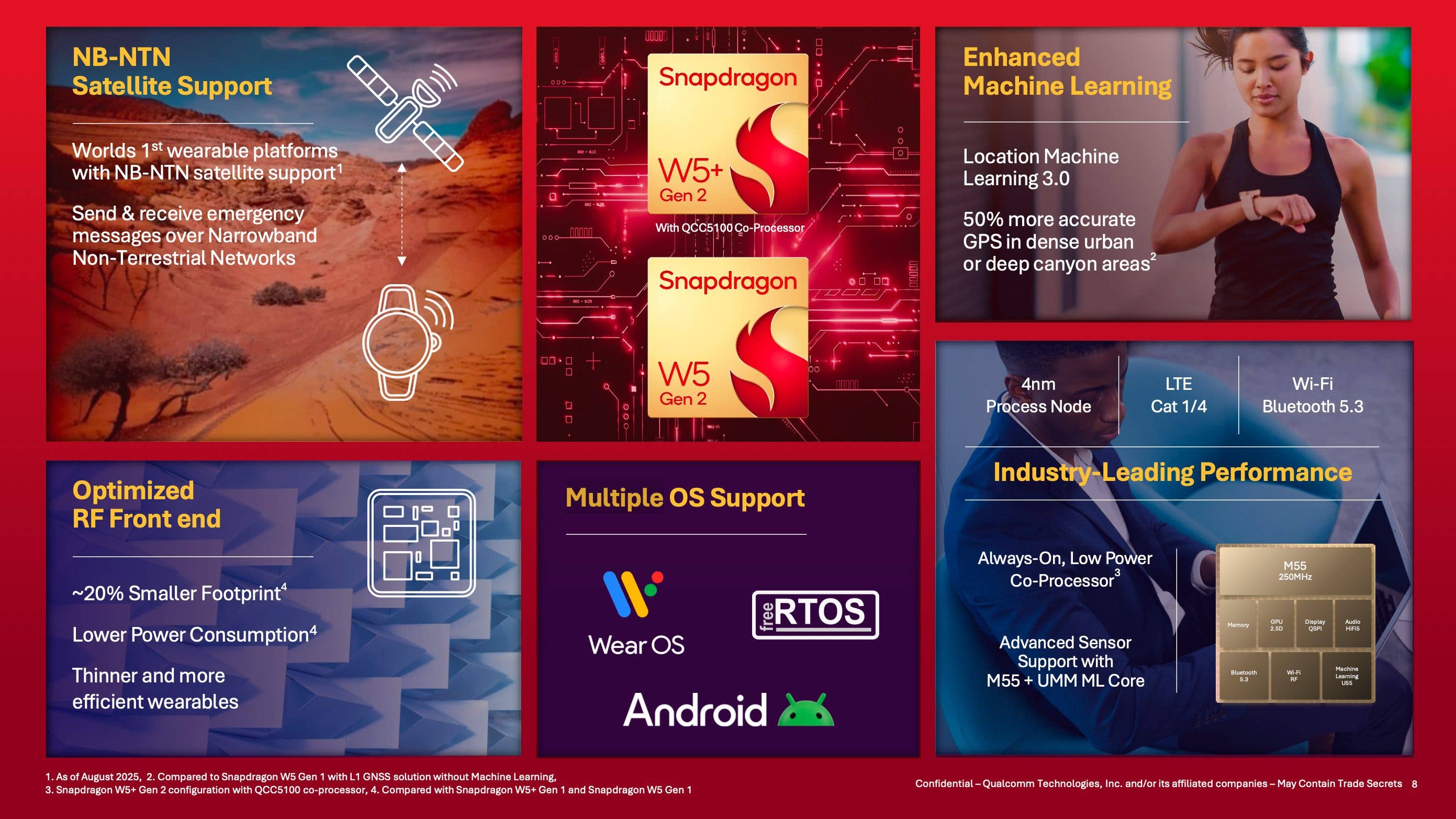
After a three-year hiatus in updating its Snapdragon chips for wearables, Qualcomm has unveiled the Snapdragon W5 Gen 2 and W5+ Gen 2. The upgrades are numerous, but a standout feature is clear: on-device satellite messaging. For the first time in the Wear OS ecosystem, users can send and receive messages via satellite directly from their watch—no smartphone needed.
The inaugural device to showcase Qualcomm’s innovative platform is the Google Pixel Watch 4, which was released today. This innovation matters significantly; unlike Apple and other competitors that still require a paired smartphone for satellite connectivity, Qualcomm has integrated the Narrowband Non-Terrestrial Network (NB-NTN) directly into the chip. This marks a transformative step in the capabilities of smartwatches.
Satellite Messaging and Enhanced GPS
Satellite messaging represents more than just a new checkbox on a feature list. It transforms the smartwatch into a reliable tool during emergencies. Imagine a hiker who loses their way, a family cut off by a storm, or a driver stranded without cell coverage. In such scenarios, being able to reach out for help directly from your wrist changes the game entirely.
Qualcomm produced a video demonstrating how the satellite messaging works. Users can select from various scenarios such as injury, getting lost, or fire. Once aligned with the satellite, the message is transmitted seamlessly. This straightforward process has the potential to save lives.
Ich bin damit einverstanden, dass externer Inhalt geladen wird. Personenbezogene Daten werden womöglich an Drittplattformen übermittelt. Nähere Informationen enthält die Datenschutzerklärung.
In addition to satellite messaging, Qualcomm has tackled another long-standing issue: location accuracy. With the new Location Machine Learning 3.0 system, GPS precision is now improved by up to 50 percent compared to the previous generation. This means fewer missed signals in urban canyons or dense forests, where older devices often struggle.
For smartwatch users, the advantages of satellite messaging and enhanced GPS shift the device into an entirely new category. It’s no longer just a fitness tracker or a notification hub—it evolves into a tool you can depend on in critical situations.
Reviving Wear OS
This advancement comes at a crucial moment. For years, Wear OS has lagged behind competitors like Apple and Samsung, which produce their own chips to maximize performance and efficiency. Qualcomm’s extended timeline without updates allowed Apple and Samsung little incentive to enhance their own processors, subsequently dampening overall market innovation.
The W5+ Gen 2 has the potential to disrupt this pattern. With a design that is smaller, more efficient, and equipped with a feature that Apple and Samsung do not offer natively on their watches, it positions Google and its partners to launch groundbreaking devices. For the first time in years, Wear OS has an opportunity not just to catch up but to take the lead.
Moreover, companies like Xiaomi and Huawei are expanding their ecosystems, particularly in markets outside the United States. Huawei has already equipped its Watch Ultimate with satellite messaging, yet Xiaomi has not ventured into this territory. This positions Qualcomm and Wear OS uniquely, bringing satellite connectivity into the mainstream ecosystem, prominently starting with the Pixel Watch 4.
The market landscape adds extra significance to this release. According to Counterpoint Research, global smartwatch shipments are beginning to plateau as the category matures. Features like fitness tracking and notifications are no longer sufficient to coax consumers into upgrading. Instead, they are searching for features that feel indispensable. Satellite SOS and enhanced GPS accuracy may fit that bill perfectly. While there remains considerable potential for growth in health and fitness features, these will no longer be the sole motivations for purchasing the next smartwatch.
If Qualcomm successfully delivers what is promised, 2025 might well be the year when Wear OS not only catches up with its competitors but begins to set the pace for the industry. A smartwatch could evolve from merely being a fitness tracker into an essential device you can genuinely rely on.