
Wearable Computing Devices Market Forecast and Outlook By Fact.MR
As we step into 2026, the wearable computing devices market is projected to reach an impressive USD 103.8 billion, following a valuation of USD 94.2 billion in 2025. By 2036, this figure is expected to skyrocket to USD 274.2 billion, reflecting a compound annual growth rate (CAGR) of 10.2%. This growth is fueled by an increasing demand for various wearable technologies, including smartwatches, fitness trackers, and more.
According to Fact.MR, there is an anticipated absolute dollar opportunity of USD 170.4 billion in the market from 2026 to 2036. This surge can largely be attributed to the accelerating convergence of consumer health monitoring, enterprise AR/VR deployment, and clinical remote patient monitoring. However, challenges such as battery life limitations in compact wearables, consumer privacy concerns regarding biometric data, and fragmented healthcare reimbursement frameworks pose hurdles for wide adoption.
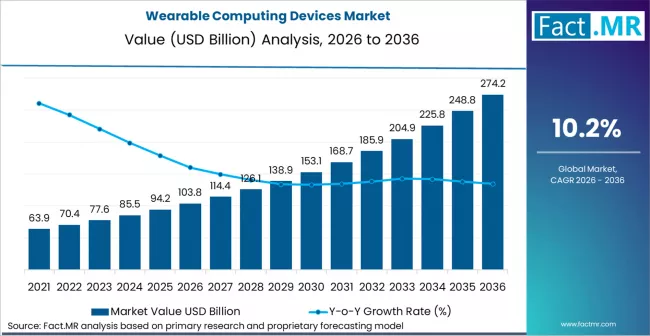
| Metric | Value |
|---|---|
| Estimated Value in 2026 | USD 103.8 billion |
| Forecast Value in 2036 | USD 274.2 billion |
| Forecast CAGR (2026 to 2036) | 10.2% |
Understanding the Market Landscape
The wearable computing devices market encompasses various body-worn electronics featuring sensors, processors, and wireless connectivity. Key products include smartwatches, fitness trackers, AR/VR headsets, ear-worn devices, smart apparel, body cameras, and industrial exoskeletons, serving sectors from consumer fitness to healthcare, enterprises, and even defense.
Market Scope
The market analysis provides comprehensive forecasts broken down by product type and application, covering everything from smartwatches to industrial exoskeletons in domains like fitness, healthcare, infotainment, and industry.
What’s Excluded?
Market analysis does not include implantable medical devices, non-wearable health monitoring systems, standalone VR consoles, or smartphone accessories lacking computing capabilities.
Research Methodology Insights
- Primary Research: Conducting interviews with OEM managers, healthcare procurement teams, and digital health policy experts.
- Desk Research: Sourcing information from OEM earnings reports, FDA databases, and studies on industrial AR deployment.
- Market Sizing: Utilizing a hybrid model based on device shipment volumes and average selling prices.
- Data Validation: Cross-verifying data with OEM revenues and IDC shipment data.
Segmental Analysis of the Wearable Computing Devices Market
Product Type Breakdown
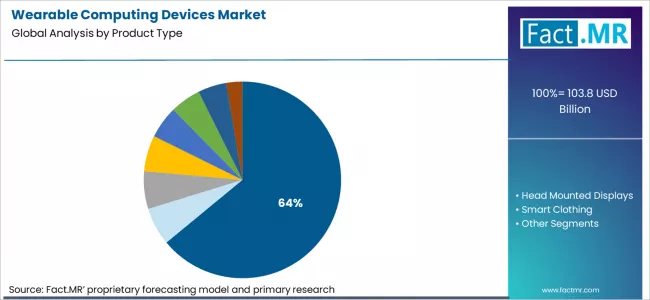
According to Fact.MR, smartwatches are set to take approximately 64% market share in 2026, providing features like health tracking, notification alerts, and payment capabilities—key reasons behind their immense popularity.
- Apple Watch Development: In 2024, Apple received FDA clearance for its sleep apnea detection feature on the Apple Watch Series 10, enabling further integration with health insurance coverage.
- Samsung’s Innovations: Samsung introduced Galaxy Watch 7 and Ultra models in 2024 featuring enhanced BioActive sensors, also receiving FDA clearance for sleep apnea detection.
- Global Shipment Trends: Reports by IDC reveal that smartwatch shipments reached 42.1 million units in Q3 2024, with Apple, Samsung, and Huawei being the leading brands.
Application Insights
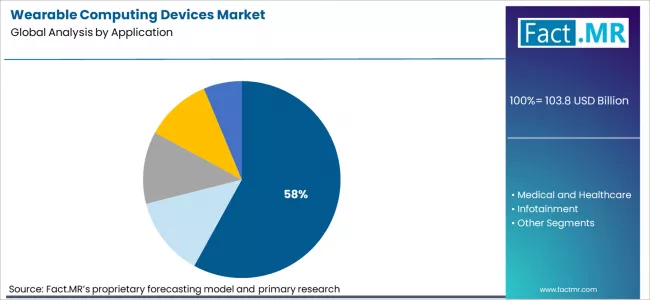
Fitness and wellness applications are projected to command around 58% market share by 2026, driven by factors like activity tracking and health monitoring.
- Garmin Partnerships: In 2025, Garmin expanded its health platform by collaborating with employer wellness programs in Europe.
- Oura Ring’s Advancements: In 2024, Oura launched a version with improved health tracking features and integrated glucose monitoring.
- Defense Applications: Microsoft supplied over 10,000 HoloLens headsets to the U.S. Army, underscoring the role of AR in defense.
Market Drivers, Restraints, and Opportunities
According to analysts at Fact.MR, the growth of the wearable computing devices market—valued at USD 94.2 billion in 2025—is powered by advancements in biometric sensors, miniaturized technology, and the digitalization of healthcare. The transition of wearable devices from basic gadgets to comprehensive health monitoring systems caters to both consumer and clinical needs.
Despite this positive growth trajectory, a divide exists between affordable fitness trackers and high-end smartwatches featuring clinical functionalities. Domestic brands in China fiercely compete on pricing, while major players like Apple and Samsung dominate the premium segment with features supporting healthcare programmes.
- FDA Approvals: The FDA’s clearance for new features like sleep apnea detection in smartwatches paves the way for better insurance coverage concerning health monitoring.
- EU Regulatory Landscape: The EU Medical Device Regulation class IIa approvals expanded in 2024, enabling wearable devices to be prescribed and reimbursed.
- China’s Industrial Growth: The Industrial Internet programme in China is promoting enterprise AR adoption, leading the way in wearable development.
Regional Market Insights
The global wearable computing devices market is analyzed across multiple regions, including Asia Pacific, Europe, North America, Latin America, and the Middle East and Africa. Each region’s demand is shaped by consumer health monitoring trends, enterprise AR deployments, and reimbursement policies.
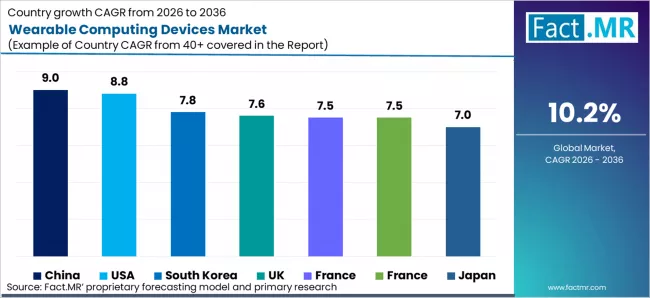
| Country | CAGR (2026-2036) |
|---|---|
| China | 9.0% |
| United States | 8.8% |
| South Korea | 7.8% |
| United Kingdom | 7.6% |
| France | 7.5% |
| Germany | 7.5% |
| Japan | 7.0% |
Source: Fact.MR analysis using proprietary forecasting models and primary research.
Asia Pacific Developments
Asia Pacific stands out as the fastest-growing region for wearable technology. China, in particular, is seeing rapid growth, driven by high demand for smartwatches and robust industrial AR applications:
- China’s Market Growth: Projected at 9.0% CAGR through 2036, driven by massive smartwatch adoption and government initiatives promoting enterprise AR solutions.
- South Korea’s Market Dynamics: With a projected CAGR of 7.8%, South Korea is advancing in high-end wearable technology and enterprise AR adoption supported by government-backed initiatives.
- Japan’s Digital Health Measures: Japan, growing at a 7.0% CAGR, is moving towards enhancing digital health systems that integrate wearable technology.
Fact.MR’s analysis in Asia covers a variety of countries, offering insights on projected growth trajectories and regional competitive dynamics.
European Wearable Market Trends
The European market is shaped significantly by regulatory requirements, especially those stemming from EU MDR standards:
- UK’s Digital Initiative: Expected to grow at a 7.6% CAGR, bolstered by funding initiatives for remote patient monitoring.
- France’s Regulatory Framework: Projecting steady market growth, the deployment of reimbursable wearable devices under new programmes enhances access.
- Germany’s Digital Compliance: With proposed regulations enhancing coverage for wearable devices, Germany’s market is looking strong for growth.
Insights into market potential across Europe help identify the best opportunities for industry players and subsidiaries.
North American Market Opportunities
North America, particularly the United States, remains a leader in revenue generation for wearable technology, thanks to Medicare coverage for health monitoring:
- U.S. Growth Potential: An 8.8% CAGR is projected, underpinned by regulatory support and corporate healthcare initiatives.
This market is ripe with opportunities, making it a focal point for both new entrants and established players in the wearable technology space.
Latin America and Emerging Markets
In Latin America, developing markets like Brazil show potential for growth as regulatory pathways for digital health devices evolve:
- Brazil’s Advancement: Steady growth driven by refreshed regulations enhancing market access for leading wearable brands.
Key insights into evolving consumer trends across Latin America offer valuable ground for both local and international brands.
Competitive Landscape and Key Players
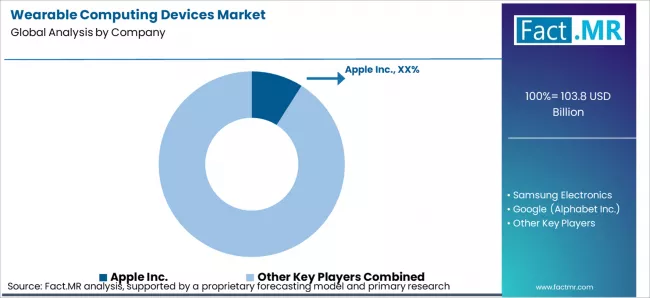
The wearable computing devices market is characterized by a blend of established names and aggressive competitors, depending on the product segment. Apple dominates premium smartwatches, while brands like Samsung and Garmin challenge in specialized niches. Market dynamics illustrate the tension between high-end and affordable segments:
Market conditions encourage continuous innovation driven by regulatory approvals and technological integrations, creating firm barriers to entry and defining competitive advantages for established players.
Leading Companies in the Market
- Apple Inc.
- Samsung Electronics
- Google (Alphabet Inc.)
- Garmin Ltd.
- Huawei Technologies Co., Ltd.
- Fitbit (Google-owned)
- Xiaomi Corporation
- Sony Corporation
- Oura Health Ltd.
Detailed Scope of Report
| Quantitative Units | USD 103.8 billion (2026) to USD 274.2 billion (2036), at a CAGR of 10.2% |
|---|---|
| Market Definition | Body-worn electronic devices including smartwatches, HMDs, smart clothing, ear-worn devices, fitness trackers, body cameras, and exoskeletons for fitness, healthcare, and industrial use. |
| Product Type Segmentation | Smartwatches, Head Mounted Displays (HMD), Smart Clothing, Ear-Worn Devices, Fitness Trackers, Body-Worn Cameras, Exoskeletons, Others |
| Application Segmentation | Fitness and Wellness, Medical and Healthcare, Infotainment, Industrial and Defense, Others |
| Application Coverage | Consumer health monitoring, clinical remote patient monitoring, AR/VR enterprise training, industrial worker safety, defense situational awareness, and sports performance tracking. |
| Regions Covered | Asia Pacific, Europe, North America, Latin America, Middle East and Africa |
| Countries Covered | China, Japan, South Korea, India, Australia and New Zealand, ASEAN, Rest of South Asia and Pacific, Germany, UK, France, Italy, Spain, Nordic countries, BENELUX, USA, Canada, Mexico, Brazil, Chile, Ecuador, and others. |
| Key Companies Profiled | Apple Inc., Samsung Electronics, Google (Alphabet Inc.), Garmin Ltd., Huawei Technologies, Fitbit (Google), Xiaomi Corporation, Sony Corporation, Oura Health Ltd. |
| Forecast Period | 2026 to 2036 |
| Approach | Hybrid top-down and bottom-up model utilizing data from device shipment volumes, average selling prices, and consumer health adoption surveys. |
Wearable Computing Devices Market by Segments
-
By Product Type:
- Smartwatches
- Head Mounted Displays (HMD)
- Smart Clothing
- Ear-Worn Devices
- Fitness Trackers
- Body-Worn Cameras
- Exoskeletons
- Others
-
By Application:
- Fitness and Wellness
- Medical and Healthcare
- Infotainment
- Industrial and Defense
- Others
-
By Region:
- North America
- United States
- Canada
- Mexico
- Latin America
- Brazil
- Chile
- Ecuador
- Rest of Latin America
- Western Europe
- Germany
- United Kingdom
- France
- Italy
- Spain
- Nordic countries
- BENELUX
- Rest of Western Europe
- Eastern Europe
- Russia
- Poland
- Hungary
- Balkan and Baltic
- Rest of Eastern Europe
- East Asia
- China
- Japan
- South Korea
- South Asia and Pacific
- India
- ASEAN
- Australia and New Zealand
- Rest of South Asia and Pacific
- Middle East and Africa
- Kingdom of Saudi Arabia
- Other GCC Countries
- Turkey
- South Africa
- Other African Union
- Rest of Middle East and Africa
- North America
Bibliography
- [1] Apple Inc. (2024). Newsroom: Apple Watch Series 10 Sleep Apnea Detection Feature FDA 510(k) Clearance Announcement as Class II Medical Device. September 2024. apple.com/newsroom
- [2] Centers for Medicare and Medicaid Services. (2024). Medicare Advantage and Part D Final Rule 2025: Supplemental Wearable Health Monitoring Device Benefit Policy and Chronic Condition Coverage Provisions. April 2024. cms.gov
- [3] European Medicines Agency and Notified Body Network. (2024). EU Medical Device Regulation 2017/745 Class IIa Digital Health Wearable Conformity Assessment Update: Withings ScanWatch 2 and Samsung Galaxy Watch ECG Certification Status. November 2024. ema.europa.eu
- [4] Ministry of Industry and Information Technology, People’s Republic of China. (2025). Industrial Internet Integration Innovation Application Programme: Enterprise AR Headset Co-Investment Grant Criteria and 2025 Programme Expansion Announcement. January 2025. miit.gov.cn
- [5] Apple Inc. (2024). Newsroom: Apple Watch Health App Milestone 100 Health and Fitness Metrics and FDA-Cleared Sleep Apnea Detection for Series 10. September 2024. apple.com/newsroom
- [6] Samsung Electronics Co., Ltd. (2024). Galaxy Watch 7 and Galaxy Watch Ultra Product Launch: BioActive Sensor Update, Blood Glucose Trend Monitoring, and Sleep Apnea FDA Clearance. July and October 2024. news.samsung.com
- [7] International Data Corporation (IDC). (2024). Worldwide Wearable Device Tracker Q3 2024: Smartwatch Shipment Volume, Year-on-Year Growth, and Vendor Share by Price Tier. December 2024. idc.com
- [8] Garmin Ltd. (2025). Press Release: Garmin Health Enterprise Wellness Programme Partnerships with European Employer Health Benefit Providers in Germany, United Kingdom, and Switzerland. January 2025. garmin.com
- [9] Oura Health Ltd. (2024). Product Launch and Partnership Announcement: Oura Ring Generation 4 Enhanced Sensing Features and Dexcom CGM Data Integration Partnership. October 2024. ouraring.com
- [10] Microsoft Corporation. (2024). IVAS Programme Update: HoloLens 2-Based Integrated Visual Augmentation System Delivery Progress to U.S. Army and IVAS Contract Status. December 2024. microsoft.com
This Report Addresses
- Strategic intelligence on FDA and EU MDR wearable medical device approvals, China MIIT AR deployment grants, Korea NHI ECG reimbursement, and NHS digital health wearable procurement.
- Market forecast from USD 103.8 billion in 2026 to USD 274.2 billion by 2036 at 10.2% CAGR, segmented by product type, application, and region.
- Growth opportunities across U.S. Medicare wearable benefits, EU wearable cardiac monitoring reimbursement, South Korea enterprise AR deployment, Japan digital health programs, and China industrial AR investment.
- Country CAGR outlook: China 9.0%, United States 8.8%, United Kingdom 8.1%, South Korea 7.8%, France 7.5%, Germany 7.5%, and Japan 7.0%.
- Competitive analysis of Apple, Samsung, Garmin, Huawei, Xiaomi, Oura Health, and Google Fitbit covering health platforms, regulatory approvals, and enterprise AR strategies.
- Technology tracking including blood glucose monitoring development, sleep apnea detection, enterprise AR headsets, industrial exoskeletons, and AI health coaching platforms.
- Regulatory analysis covering FDA 510(k) approvals, EU MDR wearable certification, UKCA registration, Japan PMDA approvals, and China NMPA wearable device regulations.
- Report delivered in PDF, Excel datasets, PowerPoint summary, and dashboard formats supported by OEM earnings reports, shipment data, regulatory databases, and primary interviews.