Exploring the Rise of Local AI Models for Coding
The Hacker News Buzz
Recently, a simple question on a Hacker News thread sparked a lively discussion: “Has anyone replaced Claude/GPT with a local model for daily coding?” As comments piled in—over 500 of them—a clearer picture began to emerge about the evolving landscape of local coding stacks. What has come to light is not just a shift in models but a shift in how developers are approaching AI-assisted coding.
Dominant Local Models
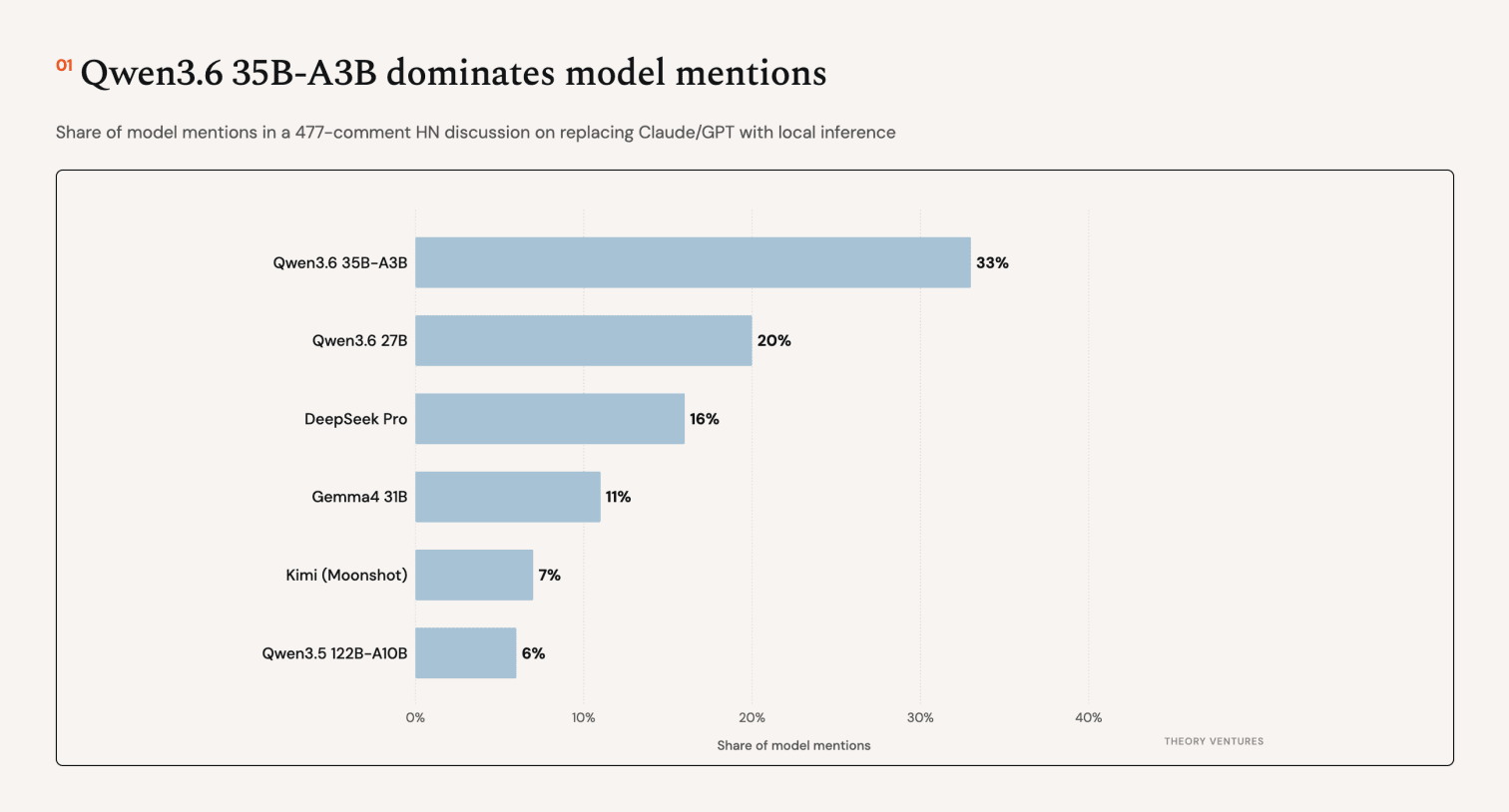
A key takeaway from the discussion is the overwhelming popularity of Qwen 3.6 35B-A3B. Remarkably, it dominated model mentions at 33%, leaving its 27B variant at 20%. Other notable contenders include DeepSeek Pro and Gemma4 31B, rounding out the top four. The commonality among these models is their use of mixture-of-experts architectures, which allow them to run efficiently on consumer-grade hardware. This efficiency is critical for developers looking to integrate AI into their workflows without investing heavily into enterprise-level infrastructure.
Agent Frameworks
When it comes to local coding agents, two clear leaders emerged: Pi and OpenCode. Pi currently holds a significant edge, appearing in 49% of the discussions, with OpenCode trail closely at 45%. Both of these frameworks are designed for lightweight local inference, making them attractive choices for developers who value speed and efficiency.

Striking a Balance: Trade-offs and Performance
The thread highlighted an interesting trade-off between using local models like Qwen 3.6 35B and cloud-based models like Claude Opus. One commenter articulated this dynamic quite well:
"Comparing agentic Qwen 3.6 35B to Claude Opus is like a junior with knowledge across the board, that you really need to guide, versus a senior that thinks with you on architecture. If Opus gives a 15x speedup, local and fully offline Qwen gives a 5x speedup."
This illustrates a critical decision-making moment for developers: do they prioritize speed and advanced capabilities of cloud models or do they lean into the privacy, cost-effectiveness, and offline capabilities offered by local models? For many, the latter’s advantages outweigh the trade-offs.
The Allure of Local Models
Privacy and cost are substantial factors driving the adoption of local models. One user encapsulated the essence of the community’s sentiment with a simple yet impactful statement:
"Given that it’s completely free, is still mind-boggling to me."
This enthusiasm highlights a broader wave of interest in local models as developers increasingly seek autonomy in their coding environments.
Emerging Performance Indicators
Benchmark data supports these discussions. The Qwen 3.6 27B model achieved an impressive score of 77.2%, while the MoE variant, Qwen 3.6 35B-A3B, garnered a score of 73.4%. These local models are achieving performance levels within striking distance of Claude Sonnet 4.6, which scored 79.6%. This performance metric suggests that local AI is reaching a maturity level where it can handle reasonably complex coding tasks effectively.

Local Models in Real-Time Practice
This development is representative of the minimill pattern, a term popularized to describe the growing trend of smaller, more efficient models supplanting massive, cloud-based systems. Once thought to be exclusive to tasks like CRM updates or simple research, local models are now proving they can be substantially effective in coding scenarios as well.
As developers embrace local AI for daily programming tasks, the landscape is shifting rapidly, indicative of a more personalized, efficient future in coding. The dialogue unfolding in forums like Hacker News reflects a fundamental transition not only in technology but in how we approach the very act of creating software. By leveraging local models, developers are carving out an era defined by independence and innovation, balancing speed, capability, privacy, and cost in a way that aligns closely with their unique needs and workflows.