
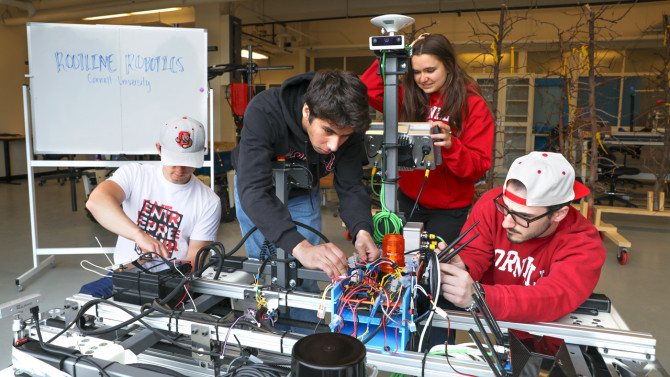
 Andrew James (from left), Neil Morrison, Natalia Kurz, and Michael Neiss work on a prototype of their weed-killing robot ahead of The Farm Robotics Challenge, which they won on May 21.
By Holly Hartigan
In a thrilling display of innovation and teamwork, a group of undergraduates from Cornell University triumphed at The Farm Robotics Challenge, taking home the coveted grand prize amidst fierce competition from 95 other teams. Their groundbreaking invention—a weed-killing robot powered by electricity—has the potential to transform agricultural practices as we know them.
Designed for use in vineyards and orchards, this autonomous robot travels through fields, zapping weeds with a targeted electrical current. By eradicating weeds without the need for harmful herbicides, the robot not only conserves labor and energy but also protects crops from competition for vital resources like water and nutrients.
Meet the Innovators
Leading the charge is Andrew James, an agricultural sciences major from the College of Agriculture and Life Sciences (CALS) at Cornell. Alongside him are his co-founders: Natalia Kurz, a bioengineering major, and Michael Neiss, combining expertise from various fields to tackle a common agricultural struggle. Over four intensive months, the team researched existing electric weeding technologies and developed their own low-energy system, culminating in a functional prototype that won the admiration of judges and fellow participants.
“There were many late nights, filled with uncertainty to boot—wondering if everything we were sacrificing was going to amount to anything,” reflected Kurz, emphasizing the emotional rollercoaster that accompanied the project. Their hard work paid off, as the team now has plans to continue refining their robot under the banner of their new company, Rootline Robotics. The $50,000 prize, sponsored by agricultural technology firm Reservoir, has given them the financial push to pursue their entrepreneurial dreams from an incubator in Sonoma, California.
The Weed Dilemma
The significance of their innovation cannot be understated. Weeds present a considerable challenge for orchardists and vineyard managers, stealing precious water and nutrients from crops, especially during the spring growing season. Steve Selin, who owns South Hill Cider in Ithaca, emphasizes the difficulties faced by organic growers as they attempt to balance weed control and tree health. “The weed pressure is very strong… If the trees get really stressed out, they’ll just drop the fruit,” he noted, highlighting the urgent need for effective weed management solutions.
Traditional methods such as string trimming and mulching are labor-intensive, consuming valuable time and resources. Moreover, existing electric weeders, which typically require an operator, are costly—averaging about $150,000—even making them unattainable for many growers. This is where Rootline Robotics hopes to step in, with a cheaper, energy-efficient alternative that can tackle weeds with far less manpower.
“If you could knock the weeds back enough during the critical months of May and June, it would greatly benefit the trees throughout the rest of the year,” Selin added. Such an approach not only preserves fruit yield but also promotes a more sustainable soil ecosystem by allowing beneficial growth—like shading from returning weeds—to occur later in the season.
The Interdisciplinary Approach to Robotics
Creating such an innovative piece of technology naturally requires the confluence of multiple fields of expertise. “Robotics is many different systems in one,” Kurz pointed out, underscoring the inherently interdisciplinary nature of the project. With backgrounds in agricultural science, biological engineering, and engineering, the team brought a spectrum of solutions to the table—a talented mixture that fostered creativity and practical problem-solving.
As the Rootline team gears up for its next phase—enhancing the existing technology and conducting field validations—their journey is far from over. With James, Kurz, and Neiss on the brink of completing their degrees, the team’s immediate future is focused on launching their product effectively while balancing their academic responsibilities. “Having diverse minds in one room gives you the ability to reach the most feasible and effective solutions,” Neiss affirmed, echoing the team’s collaborative spirit.

Cornell University