
Report Overview
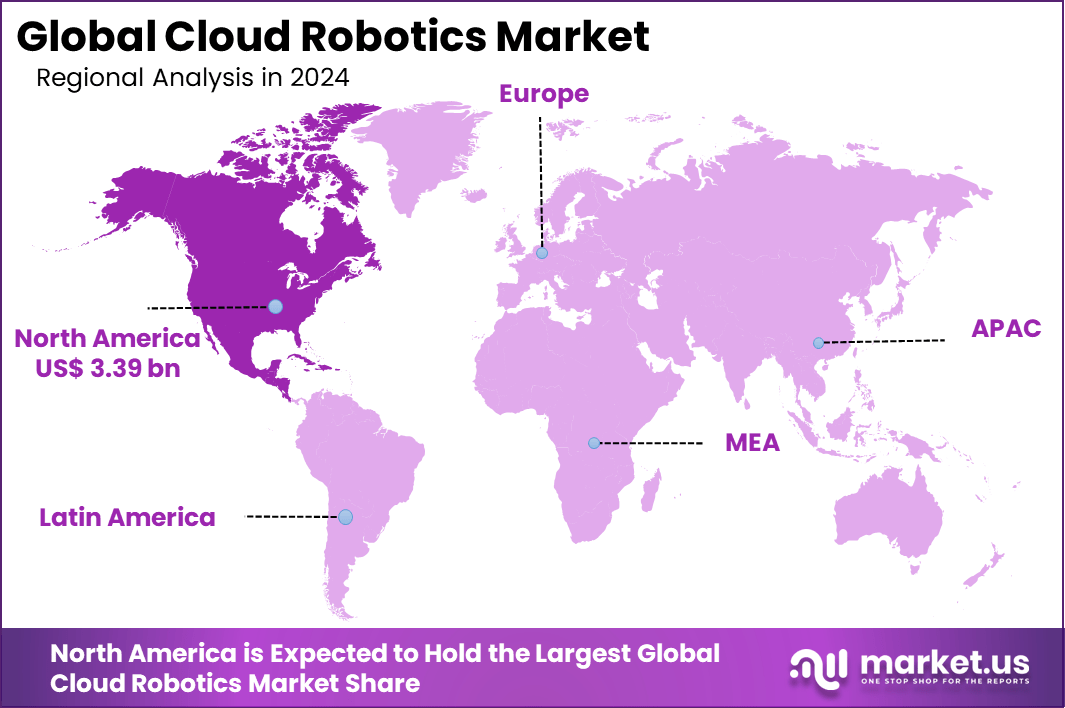
The Global Cloud Robotics Market size is on a remarkable trajectory, projected to reach around USD 73.79 billion by 2034. This expansion from USD 8.94 billion in 2024 reflects a robust compound annual growth rate (CAGR) of 23.5% from 2025 to 2034. As of 2024, North America was at the forefront, commanding a significant market share of over 38% and generating approximately USD 3.39 billion in revenue.
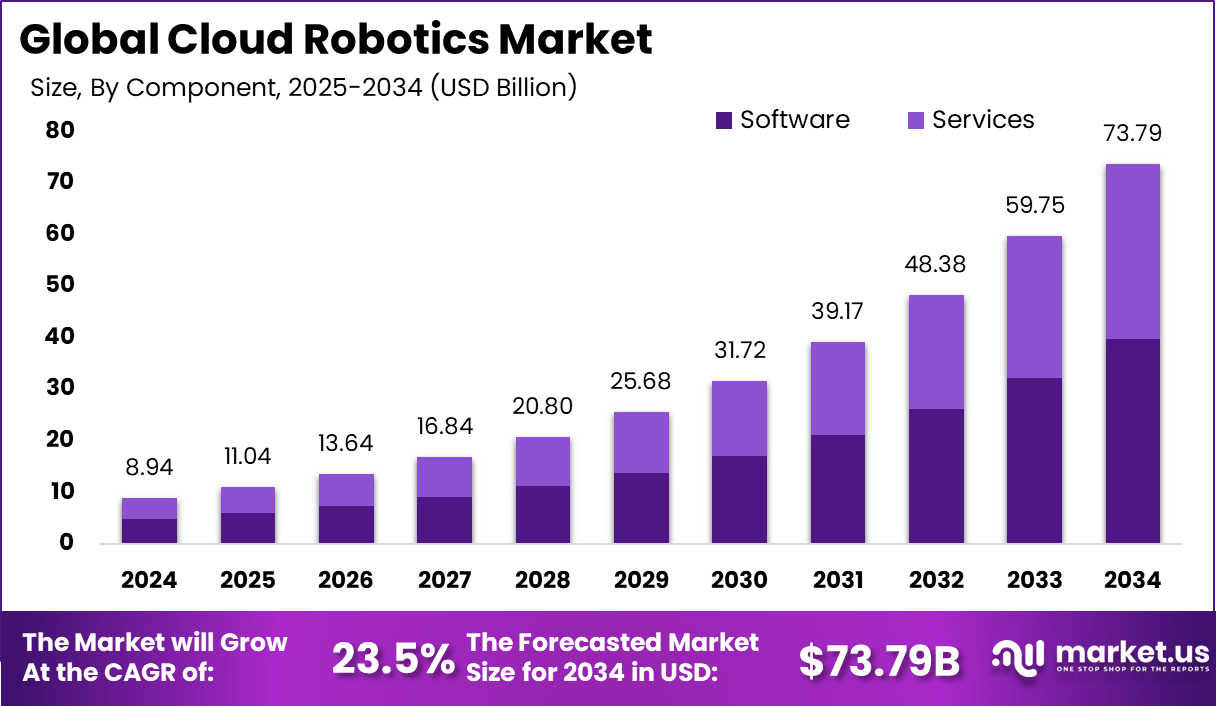
The driving forces behind the Cloud Robotics Market’s growth include significant advancements in artificial intelligence, robust machine learning, and the advent of high-speed connectivity. Industries’ increasing push toward automation, alongside the scalability and cost-effectiveness of cloud-based solutions, is further fueling this trend. The ability to enhance robotic capabilities through cloud integration is also fostering this growth.
The introduction of 5G technology and the implementation of edge computing bolster cloud robotics deployment, providing low-latency communication and improved data processing. There’s particularly high demand for cloud robotics within sectors like manufacturing, healthcare, logistics, and agriculture, where intelligent automation solutions are increasingly vital. For instance, in July 2024, Vention launched AI-powered tools within its Manufacturing Automation Platform (MAP), which accelerated robotic work cell design and deployment. These updates featured advanced 3D design and cloud-based robot deployment directly to factory floors.
Technological innovations play a pivotal role in adopting cloud robotics. By integrating artificial intelligence and machine learning, robots can learn from experience and continuously enhance their performance. High-speed internet, especially through 5G networks, facilitates rapid data exchange between robots and cloud servers, enabling real-time decision-making.
Key Takeaways
- In 2024, the Software segment led the global cloud robotics market, comprising 54% of the total market share due to the increased integration of cloud-based control systems.
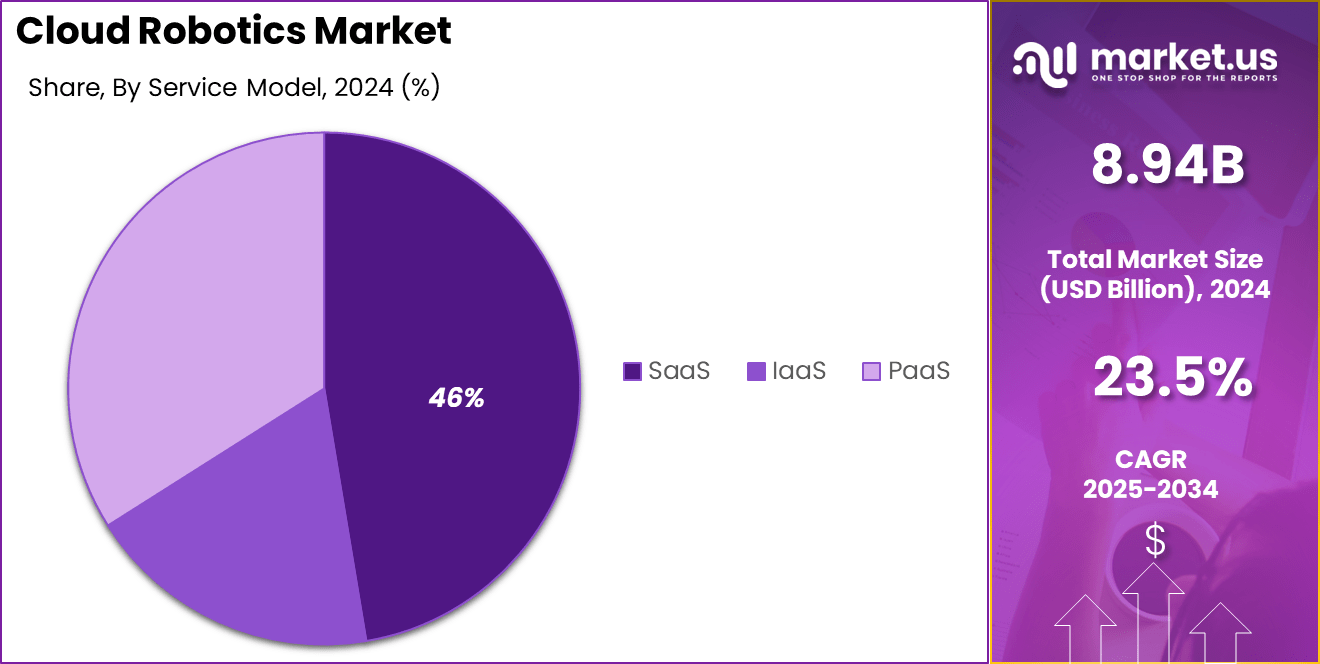
- The Software as a Service (SaaS) model closely followed with a 46% share, attracting interest because of its scalability and reduced upfront costs.
- Cloud-enabled industrial robots in retail captured a significant 40% market share in 2024, driven by automation demands in inventory management and customer service.
- The Verticals segment dominated use-case deployments, encompassing 74% of the global market, reflecting widespread adoption across different sectors.
- The U.S. cloud robotics market reached USD 3.2 billion in 2024, displaying a notable 21.7% CAGR, showcasing growing enterprise adoption across sectors.
- North America retained its leadership in the global market, holding more than a 38% share in 2024, fueled by advanced robotics infrastructure and early adoption of cloud technology.
The Role of AI in Cloud Robotics
Artificial Intelligence (AI) is revolutionizing the cloud robotics landscape by enabling robots to tackle intricate tasks with the help of cloud resources. AI facilitates real-time data processing, improved learning capabilities, and optimized decision-making—all essential for deploying intelligent robotic systems across various sectors.
Through AI, robots can learn from past experiences, adapt to new surroundings, and perform tasks with increasing independence. In the manufacturing realm, for instance, AI-powered cloud robotics systems are enhancing productivity by automating complex workflows and minimizing human intervention.
The fusion of AI in cloud robotics also supports robotic systems’ scalability. By delegating computation needs to the cloud, robots can operate with minimized onboard hardware, cutting costs, and reducing energy consumption. This design allows for extensive fleets of robots that can be systematically managed and updated, ensuring uniform performance in diverse applications.
U.S. Market Size
The U.S. Cloud Robotics Market is estimated to reach approximately USD 3.2 billion in 2024, anticipated to magnify from USD 8.5 billion in 2029 to about USD 22.8 billion by 2034, with a projected CAGR of 21.7% from 2025 to 2034.
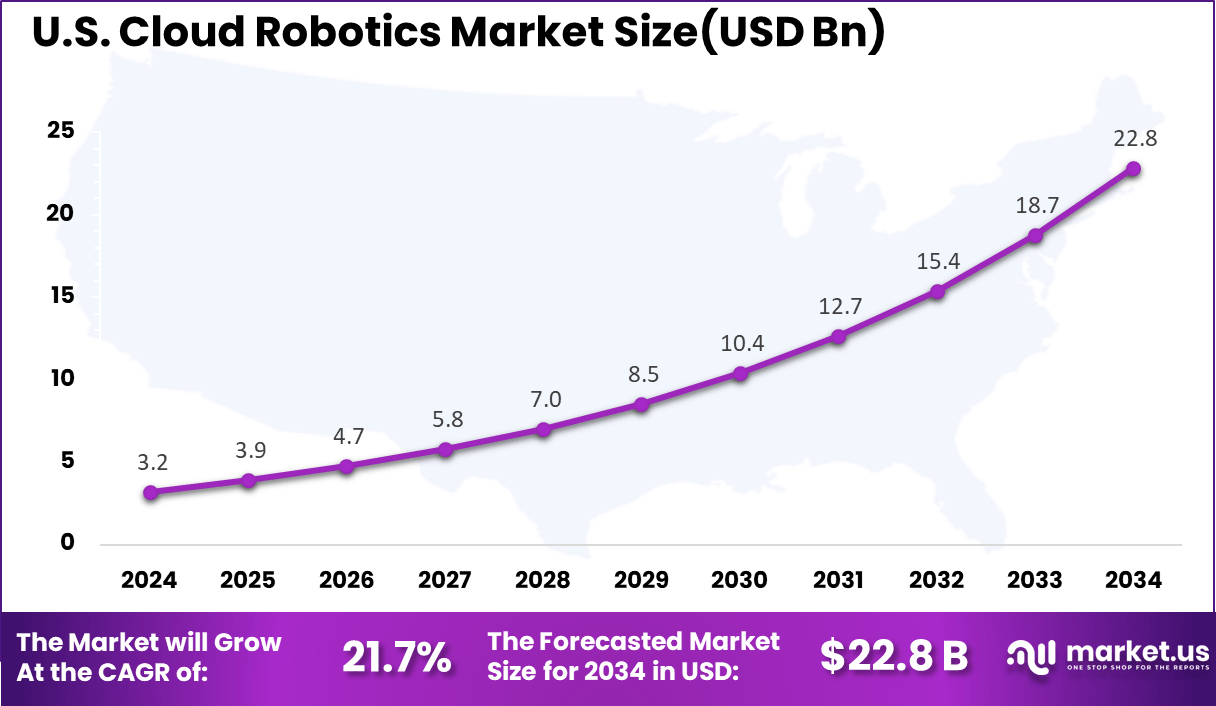
In 2024, the North American region dominated the global Cloud Robotics Market, capturing over a 38% share and generating USD 3.39 billion in revenue. The U.S. has secured its top position thanks to a mix of technological breakthroughs, industrial adoption, and strategic moves by leading companies.
Tech giants like Microsoft, Google, Amazon, and NVIDIA are at the forefront, developing innovative cloud-based robotic solutions. For instance, NVIDIA’s Jetson Thor platform showcases advancements in robotics, integrating both hardware and software efficiently.
Component Analysis
In 2024, the software segment dominated the cloud robotics landscape, claiming more than 54% of the overall market share. This dominance stems from the rising demand for advanced robotic features that heavily depend on software solutions.
Software in cloud robotics includes middleware, frameworks, and algorithms critical for data processing, experiential learning, and real-time decision-making. The proliferation of AI and machine learning (ML) technologies has further accelerated the growth of this segment, as they necessitate sophisticated software platforms for successful implementation.
For example, in April 2025, Realtime Robotics unveiled Resolver, its cloud-based tool that accelerates robotic work cell design and implementation. With sophisticated algorithms, it efficiently generates collision-free motion paths, cutting design time significantly and reducing required engineering efforts.
The software segment’s supremacy is bolstered by its vital role in ensuring interoperability and integration among different robotic systems. As enterprises embrace varied robotic fleets, the demand for unified software platforms to manage and coordinate these operations becomes increasingly crucial.
Moreover, software updates and maintenance can be executed remotely, which minimizes operational downtime. The continuous evolution of software, which includes innovative user interfaces and analytics tools, guarantees that this segment remains at the cutting edge of cloud robotics innovation.
Service Analysis
In 2024, the Software as a Service (SaaS) segment held a strong position in the cloud robotics market, encompassing more than 46% of the total market share. This rise is driven by the increasing need for scalable, cost-effective solutions that offer businesses access to advanced robotic functionalities without significant investment in infrastructure.
In March 2025, SVT Robotics announced a cloud-based portal for its SOFTBOT® Platform, designed for central control over automation across various locations. This portal allows real-time issue tracking, unified management of engines, and enhances troubleshooting, streamlining operations and optimizing IT resources.
The SaaS model allows organizations to deploy and control robotic applications through cloud platforms, ensuring flexibility and simple integration across sectors. Its leading market position is reinforced by the model’s capacity for rapid deployment and continuous updates, granting users access to the latest advancements.
This is particularly beneficial in manufacturing, healthcare, and logistics, where operational efficiency and adaptability are paramount. The SaaS model also supports remote monitoring and management, fostering real-time decision-making and minimizing the need for on-site technical assistance. As companies prioritize agility and digital transformation, SaaS adoption in cloud robotics is forecasted to see continued growth, reinforcing its status at the helm of this market.
Application Analysis
As of 2024, the Industrial Robots segment held a significant portion of the cloud robotics market, accounting for over 40% of market share. This leadership arises from the increasing integration of cloud computing with industrial automation, enabling robots to execute complex tasks with greater efficiency and adaptability.
The use of cloud robotics in industrial environments enables real-time data processing, remote monitoring, and coherent collaboration among machines—essentials for optimizing manufacturing processes and minimizing operational expenses. The strong presence of industrial robots within the cloud robotics space is further driven by a growing overall demand for automation in various sectors, such as automotive, electronics, and logistics.
These industries are leveraging cloud-enabled robots to boost productivity, ensure precision, and maintain high standards of quality in production lines. Additionally, the scalability of cloud robotics allows organizations to swiftly adapt to fluctuating production requirements without making substantial investments in physical infrastructure.
For instance, in May 2025, Amazon unveiled Vulcan, its first warehouse robot equipped with tactile sensing capabilities powered by AI, allowing it to identify and handle approximately 75% of warehouse items by touch—an impressive advancement over previous vision-dependent systems. This leap has significantly enhanced efficiency, revitalizing how items are stowed across various shelving levels and alleviating physical strain on human workers.
End-User Analysis
In 2024, the Verticals segment held a commanding position in the global cloud robotics sector, accounting for over 74% of the overall market share. This dominance reflects widespread adoption across multiple industries, including manufacturing, healthcare, logistics, and retail.
Industries employ cloud-based robotic solutions to amplify operational efficiency, scalability, and real-time data processing capabilities. Centralized control, remote monitoring, and seamless updates have become key objectives for sectors intent on optimizing processes and trimming operational costs.
Manufacturing has notably been at the vanguard in adopting cloud robotics, facilitating smart factory initiatives and transitioning towards Industry 4.0. Utilizing cloud-connected robots, manufacturers attain heightened levels of automation, predictive maintenance, and adaptable production lines.
In May 2025, Agility Robotics announced Agility Arc, a cloud-based fleet management tool designed for coordinating multiple humanoid robots in industrial settings, thereby allowing centralized control of activities like material handling and inventory management. This launch underlines a growing reliance on cloud solutions to oversee complex robotic operations, affirming the Verticals segment’s strength within the cloud robotics market.
Key Market Segments
By Component
- Software
- Services
- Consulting services
- Implementation services
- Training and support services
By Service Model
- Software as a Service (SaaS)
- Robotics as a Service (RaaS)
- Infrastructure as a Service (IaaS)
By Application
- Industrial Robots
- Customer Robots
- Military Robots
- Commercial Robots
By End-user
- Third-party users
- Verticals
- Manufacturing
- Defense
- Banking, Financial Services, and Insurance (BFSI)
- Transportation and Logistics
- Healthcare and Life Sciences
- Retail
- Others (agriculture, education, and entertainment)
Drivers
Integration of Cloud Computing and AI
The combination of cloud computing and artificial intelligence (AI) represents a critical driving force behind the evolution of cloud robotics. This synergy enables robots to access extensive computing resources, permitting real-time data processing and informed decision-making.
By using sophisticated AI algorithms, cloud robotics can enhance functionalities, including object recognition, path planning, and adaptive learning. The scalability provided by cloud platforms allows robots to be continuously updated and refined without requiring hardware adjustments.
In April 2025, Locus Robotics announced surpassing 5 billion picks globally, signifying rapid advancement in mobile warehouse automation. This milestone demonstrates the growing reliance on autonomous mobile robots (AMRs) as essential tools in contemporary logistics. The company’s Robotics-as-a-Service (RaaS) model plays a pivotal role, offering scalable and flexible automation solutions that cater to dynamic industry needs.
Moreover, cloud infrastructure supports collective learning among robotic systems. Data gathered by individual robots can be aggregated and analyzed centrally, leading to shared insights and quicker learning processes across the robotic fleet. This collective intelligence enhances not only individual robot efficacy but also aids in developing robust and adaptable robotic applications.
Restraints
Data Security and Privacy Concerns
Despite its potential, concerns regarding data security and privacy act as significant hindrances to widespread cloud robotics adoption. The digital architecture necessitates transmitting and storing sensitive data, which increases vulnerability to data breaches and unauthorized access.
Sectors like healthcare and manufacturing, where confidentiality is paramount, show heightened skepticism towards cloud-based robotic solutions. The risk of cyberattacks on cloud servers or communication channels raises questions about the reliability and safety of these systems.
As an example, in March 2025, Oracle Cloud faced a substantial data breach affecting over 140,000 businesses, imperiling around 6 million records. This incident, associated with a suspected supply chain attack, involved compromising encrypted credentials and private security keys, emphasizing the urgency of addressing security concerns in cloud robotics deployments.
Opportunities
Healthcare Sector Growth Potential
The healthcare industry presents expansive opportunities for cloud robotics. Integrating robotic systems with cloud computing can dramatically enhance patient care through improved surgical precision, automating mundane tasks, and enabling remote monitoring. For example, cloud-connected surgical robots can access real-time data and analytics, thereby improving surgical outcomes and shortening recovery periods.
Additionally, employing service robots in hospitals for logistics, such as medication delivery and sanitation, can relieve the workload on healthcare personnel, allowing them to focus more on patient care. The adaptability of cloud robotics ensures healthcare facilities can respond to fluctuating demands without significant shifts in infrastructure.
Challenges
Network Latency Impact
Network latency has emerged as a vital challenge in applying cloud robotics, particularly in applications requiring instantaneous responsiveness. The reliance on cloud servers for processing means that delays in data transmission can significantly impair robotic system performance. In operations that are time-sensitive—like autonomous navigation or real-time human interaction—latency issues may lead to suboptimal outcomes or safety hazards.
To counteract these challenges, edge computing is gaining traction. By processing data close to its source, edge computing reduces dependence on remote cloud infrastructure, thereby mitigating latency concerns. However, integrating edge computing introduces complicating factors related to infrastructure investment and system coherence.
Emerging Trends in Cloud Robotics
Decentralized cloud robotics architectures are on the rise, distributing processing tasks between cloud servers and edge devices. This strategy reduces latency, enhancing the responsiveness of robotic systems necessary for real-time decision-making applications.
The rollout of 5G connectivity supports this trend, delivering efficient communication channels for faster data exchange between robots and cloud platforms. An additional significant evolution is the emergence of Robotics-as-a-Service (RaaS) models, allowing businesses to subscribe to robotic solutions.
This model lowers the accessibility barrier for adopting advanced robotics, broadening access across various industries. Furthermore, utilizing digital twins—virtual replicas of physical systems—can aid simulation and optimization of robotic operations, enhancing performance while minimizing downtime.
Business Benefits
Enhanced Operational Efficiency
Implementing cloud robotics can dramatically heighten operational efficiency by allowing centralized monitoring and control of robotic systems. This approach facilitates real-time updates, predictive maintenance, and streamlined workflows, collectively reducing downtime and elevating productivity.
For example, in manufacturing contexts, cloud-connected robots can rapidly adjust to evolving production requirements, ensuring consistent quality and output. Additionally, cloud robotics offers resource scalability, enabling businesses to align their robotic infrastructure with demand, enhancing resource allocation efficiency.
The option to remotely monitor and manage robotic systems also decreases reliance on on-site personnel, driving further cost reductions and operational agility. These collective advantages position cloud robotics as a strategic asset for companies looking to remain competitive in an increasingly automated environment.
Regional Analysis
Europe
Europe showcases a steady adoption of cloud robotics, spurred by a strong focus on automation and digital transformation.
Key Trends:
- Integration of cloud robotics within manufacturing and logistics for operational efficiency.
- Expanding investments in research and development aimed to enhance robotic capabilities.
- Movement towards standardized protocols for seamless robot-cloud communication.
Asia Pacific
The Asia Pacific region is becoming a formidable player in the cloud robotics space, fuelled by rapid industrialization and technological developments.
Key Trends:
- China’s significant investments in AI and robotics positioning it as a global leader in the field.
- Japan’s emphasis on humanoid robots for healthcare and eldercare automation.
- India’s commitment to adopting cloud robotics within agricultural and manufacturing sectors.
- South Korea’s advancements in 5G technology that enable real-time robotic applications.
Latin America
Latin America is slowly embracing cloud robotics, with prominent countries like Brazil and Mexico at the helm.
Key Trends:
- Rising investments in automation to enhance operational efficiencies across sectors.
- Cloud robotics adoption in manufacturing and logistics, addressing existing labor shortages.
- Developing local expertise and infrastructure to foster better robotic integration.
Middle East & Africa
The Middle East and Africa are witnessing impressive growth in cloud robotics, driven by a burgeoning e-commerce landscape and an increasing need for automation in logistics.
Key Trends:
- Implementation of automation technologies to improve supply chain efficiencies.
- Government initiatives encouraging industrial automation and smart infrastructure deployments.
- Investments targeted at developing skilled labor to sustain the growing robotics sector.
Key Regions and Countries
- North America
- Europe
- Germany
- France
- The UK
- Spain
- Italy
- Rest of Europe
- Asia Pacific
- China
- Japan
- South Korea
- India
- Australia
- Singapore
- Rest of Asia Pacific
- Latin America
- Brazil
- Mexico
- Rest of Latin America
- Middle East & Africa
- South Africa
- Saudi Arabia
- UAE
- Rest of MEA
Key Players Analysis
Hit Robot Group Co. Ltd, based in China, is a key player in the cloud robotics arena, focusing on merging cloud computing with robotic technology to enhance automation across various industries. Their commitment to research and development has initiated innovations within smart manufacturing and intelligent logistics, cementing their position in the Asian market.
ABB Ltd, headquartered in Switzerland, stands out as a global technology firm with significant contributions to industrial automation and robotics. In the cloud robotics field, ABB’s solutions incorporate cloud computing with robotic systems to bolster efficiency and adaptability in manufacturing processes.
inVia Robotics Inc., an American enterprise, specializes in providing cloud-based robotics solutions aimed at warehouse automation. Their offerings consist of autonomous mobile robots and software that optimize inventory management and order fulfillment operations, presenting scalable options for e-commerce and logistics businesses.
Top Key Players in the Market
- Hit Robot Group Co. Ltd
- ABB Ltd
- inVia Robotics Inc.
- C2RO Cloud Robotics
- CloudMinds Technologies Co. Ltd
- Google LLC
- IBM Corporation
- Microsoft Corporation
- Rapyuta Robotics Co. Ltd
- Tend AI Inc.
- V3 Smart Technologies PTE Ltd
- Others
Recent Developments
- Nauticus Robotics announced the acquisition of SeaTrepid International in March 2025, aiming to enhance its abilities in subsea robotics and cloud integration, thus strengthening its influence in the maritime robotics domain.
- SVT Robotics introduced the cloud-based SOFTBOT Portal in March 2025, designed to expedite the deployment and management of robotics systems, catering to the rising demand for versatile automation solutions in manufacturing and logistics.
- In February 2024, Zebra Technologies acquired Fetch Robotics, reinforcing its capabilities in manufacturing, logistics, and industrial automation sectors, thereby enhancing its portfolio through integration with Fetch Robotics’ advanced offerings.
Report Scope
This structure provides an organized, insightful examination of the Cloud Robotics Market, highlighting its rapid growth, pervasive applications, key players, and emerging trends—all in a conversational tone that’s easy to comprehend.