
In a groundbreaking development, scientists in Germany are harnessing the power of artificial intelligence to create automated drones and robots capable of detecting radioactive waste. This innovation is particularly crucial in hazardous environments where human intervention could be unsafe or altogether impossible. The advancements stem from research conducted at the Fraunhofer Institute for Communication, Information Processing and Ergonomics (FKIE), showcasing the potential of technology to improve safety and efficiency in risk-laden situations.
The project combines uncrewed aerial systems (UAS) and uncrewed ground vehicles (UGV) with enhanced sensor fusion, automation, and probabilistic search algorithms. This fusion allows the team to streamline the process of identifying radioactive, chemical, or biological hazards, especially in emergency situations. Notably, their technology demonstrator can locate radioactive sources with remarkable precision, narrowing down the location to within just a few feet. Preliminary field trials have demonstrated encouraging outcomes, underscoring the project’s viability and potential future applications.
The Need for Fast Detection
One particularly striking illustration of the technology’s potential is rooted in a real-world incident from 2023, which highlighted the critical need for rapid response mechanisms. A small radioactive cesium-137 capsule, just eight millimeters long, accidentally fell from a truck during transport between Perth and a Rio Tinto mine site in Australia’s Pilbara region. The fallout necessitated an extensive search operation spanning 869 miles (1,400 kilometers) of highway, where specialist teams struggled to locate the capsule, ultimately relying on handheld detectors.
“The cesium capsule in Australia could only be found after days of searching,” noted Claudia Bender, a researcher at Fraunhofer FKIE. “We could have found the radioactive capsule much more quickly using our UAS.” This incident illustrates the urgency for automated solutions that can significantly reduce search times in hazardous circumstances.
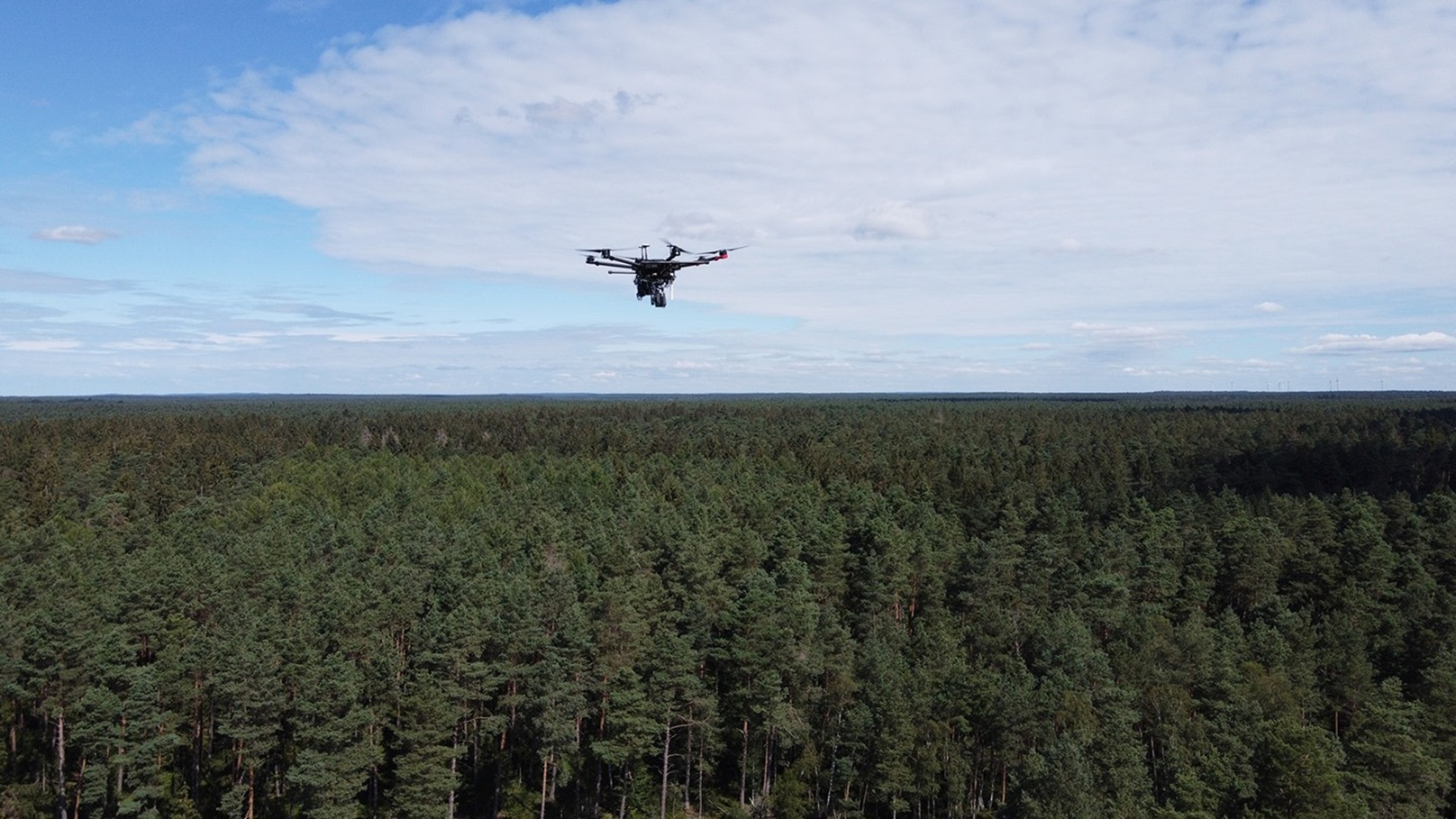
The technology operates through a two-phase detection process: an exploration phase followed by a targeted search phase. Initially, the drone adheres to a predefined flight pattern, continuously measuring background radiation levels. Upon detecting an anomaly, the system transitions to a proactive search mode, dynamically adjusting its flight path based on real-time sensor data and previously gathered information. This level of adaptability is crucial for effective and efficient identification of hazardous materials.
Innovations in Radiation Detection
The detection system is powered by stochastic algorithms that assess the likelihood of a radioactive source’s location. As the drone collects data, it autonomously generates waypoints, converging on the most probable position of the hazard. Simultaneously, it creates radiation intensity maps and probability maps, visually representing areas with the highest chances of containing dangerous material.
Equipped with sophisticated gamma detectors, electro-optical, and infrared cameras, the drone enhances its detection capabilities. An Intel NUC computer processes data while an inertial measurement unit (IMU) keeps track of the drone’s position in three-dimensional space. This comprehensive suite of tools allows the drone to create live images, enabling operators to identify objects such as people, vehicles, or buildings, all mapped in real time.

Credit:Fraunhofer FKIE/Fabian Vogl
In addition to aerial reconnaissance, the Fraunhofer FKIE is extending its research to ground-based robots capable of navigating environments that remain perilous even after aerial assessments. These ground robots integrate CBRNE sensors, autonomous navigation, and geodata processing. They serve multiple functions, including confirming threats, mapping hazardous regions, and aiding recovery operations.
One notable prototype includes a “click and grasp” system, enabling operators to interact directly with objects displayed on a live video feed. This robotic arm can not only autonomously pick up and analyze radioactive materials but can also perform intricate actions like opening car doors. Such functionalities significantly enhance operational efficiency in emergency scenarios, where precise interaction with hazardous materials is crucial.
Additionally, ongoing research is focusing on developing 3D visualization and intuitive control systems that allow robots to replicate human arm movements. Dubbed “jacket control,” this innovative feature enables even untrained emergency personnel to intuitively operate the robots, ultimately broadening the usability of such advanced technologies.