
Cloud Computing Services Market Insights
Overview of the Market
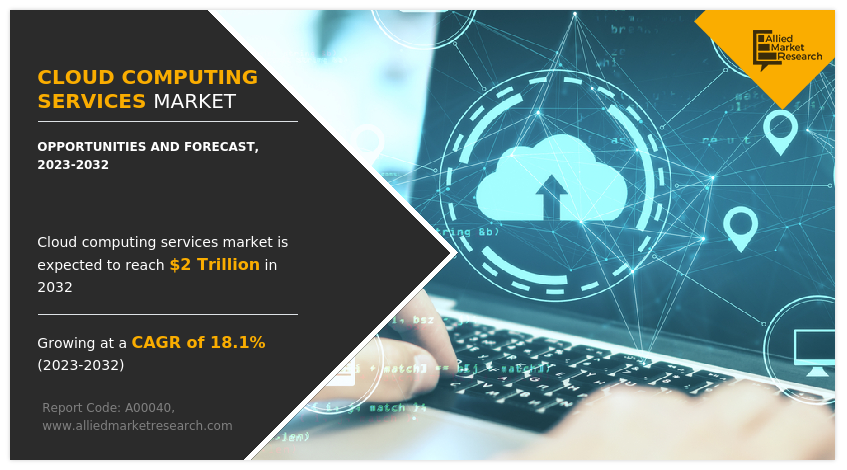
The global cloud computing services market has seen exponential growth, valued at approximately USD 398.9 billion in 2022. Projections indicate a staggering leap to USD 2 trillion by 2032, which corresponds to a compound annual growth rate (CAGR) of 18.1% between 2023 and 2032. This growth is largely driven by the increasing demand for cloud services, aimed at enhancing business operations, coupled with the rising usage of mobile devices among consumers and employees.
Significant technological advancements and escalating investments from major industry players are also creating numerous opportunities within this sector. A notable example is IBM Corporation’s recent launch of the IBM Hybrid Cloud Mesh in May 2023, a Software as a Service (SaaS) offering that allows enterprises to manage their hybrid multi-cloud infrastructures seamlessly. This innovation seeks to empower organizations to deploy applications and services across varied environments efficiently and securely.
Technology Insights
As more businesses migrate to cloud-based infrastructures, the cloud computing services market is rapidly evolving. Current trends indicate that organizations increasingly depend on advanced monitoring tools provided by cloud service giants like Microsoft Azure. These tools offer critical visibility into application performance, availability, and usage, allowing businesses to monitor their cloud applications in real-time. This visibility is crucial for effective decision-making and proactive troubleshooting.
The rising adoption of cloud computing across various industries has heightened the demand for tools that monitor performance, security, and infrastructure. These include cloud performance monitoring platforms, security solutions, and application performance management tools. Not only do these tools optimize application performance, but they also ensure reliability and enhance user experience by analyzing user behavior. Yet, challenges remain, such as data privacy concerns and budget constraints that can hinder market growth.
Simultaneously, the market is poised to offer abundant opportunities, driven by increasing digital transformation strategies. Remote work, the need for scalable infrastructure, and reliance on data-driven decision-making are significant factors propelling the cloud industry’s expansion. Additionally, the growing demand for Software as a Service (SaaS) platforms is streamlining processes across sectors, from finance to healthcare.
The integration of artificial intelligence (AI) and machine learning (ML) into cloud services promises an added layer of value. Companies can leverage these technologies to enhance customer experiences and streamline operations. The pressing focus on cybersecurity offers another avenue for cloud service providers to create superior, secure solutions.
Current Trends in Cloud Computing
The cloud computing landscape is in a state of constant evolution, characterized by several significant trends. A prominent movement is toward multi-cloud strategies, where businesses leverage multiple cloud providers to avoid vendor lock-in and improve flexibility. Furthermore, there is a shift towards edge computing, where data processing occurs closer to its source, thereby minimizing latency and boosting performance.
AI and ML technologies are increasingly integrated into cloud offerings, facilitating automated insights and predictive analytics. Another rise is in serverless computing, which allows developers to focus solely on coding, without being bogged down by infrastructure management. As organizations increasingly adopt cloud solutions, security remains a priority, with emphasis on advanced encryption and AI-driven threat detection tools to safeguard sensitive data.
A testament to these advancements is Akamai Technologies, which opened three new cloud computing sites in July 2023 to support modern applications that demand higher performance and lower latency. By integrating compute and storage functionalities, Akamai aims to redefine application and data management, using its extensive edge network to enhance global connectivity.
Future Trends in Cloud Computing
Looking ahead, several promising trends are set to shape the future of the cloud computing market. The continued adoption of multi-cloud and hybrid environments will help businesses to remain flexible and avoid dependency on a single provider. Edge computing is also anticipated to gain significant traction, enhancing real-time analytics and operational efficiency.
The integration of AI and ML into cloud services is likely to foster advancements in automated decision-making and improved security mechanisms. Likewise, serverless computing is expected to gain momentum, allowing developers to prioritize application development over infrastructure management. Emerging security features will include AI-driven threat detection and zero-trust architectures, enabling a robust framework for secure cloud operations.
As an example, in March 2025, Google Cloud expanded its collaboration with Deutsche Telekom and Vodafone Italy to enhance AI-driven network operations and cloud data modernization. This partnership highlights a growing emphasis on intelligent network management and efficient data handling.
Segment Review
The cloud computing services market is segmented on various fronts, including service type, enterprise size, end-use, and region. Service types include Infrastructure as a Service (IaaS), Platform as a Service (PaaS), and Software as a Service (SaaS). Each category offers unique solutions catering to different business requirements.
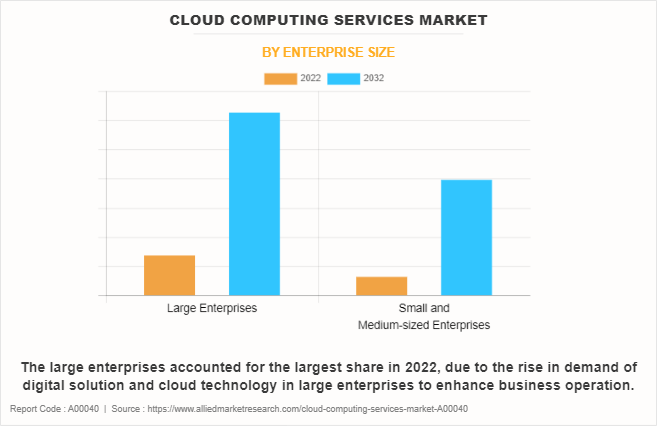
By enterprise size, the market is dominated by large enterprises, although small and medium-sized enterprises (SMEs) are expected to witness the highest growth in the coming years. This shift occurs because SMEs often leverage cloud services for cost-effective and scalable solutions during their initial deployment phases.
Regionally, North America was the leading market player in 2022, bolstered by the presence of significant cloud service providers such as Google, IBM, and Amazon. However, Asia-Pacific is projected to experience the most substantial growth due to increased digitalization and cloud adoption.
Top Impacting Factors
Increasing Availability of Cloud-Based Services
The adoption of cloud computing services offers significant economic benefits, including cost savings and reductions in capital expenditures. With cloud solutions, businesses can decrease their reliance on physical IT resources, resulting in minimal initial investments. Studies show that cloud deployment can save businesses up to 50-60% in total cost of ownership. A survey by Booz Allen Hamilton corroborates this, highlighting that 88% of business executives acknowledge cost-cutting as a primary benefit of cloud services.
Type Insights
The cloud computing services market primarily categorizes into IaaS, PaaS, and SaaS. IaaS delivers virtualized computing resources over the internet, appealing to businesses requiring scalable infrastructure, while PaaS simplifies application development and management by eliminating hardware complexities. SaaS, on the other hand, offers internet-based software applications on a subscription basis, highlighting extensive accessibility, scalability, and lowered IT maintenance costs.
Competition Analysis
Key players in the cloud computing services market include industry giants like Microsoft, Google, VMware, IBM, Alibaba Cloud, Oracle, SAP, Salesforce, Atos, and AWS. These companies are actively engaging in partnerships, product launches, and other growth strategies to fortify their positions in the competitive landscape.
Key Industry Development
In October 2023, Microsoft enhanced its cloud services to improve productivity and security, underscoring its commitment to remaining competitive in the evolving market. Additionally, VMware introduced new advancements in its multi-cloud computing infrastructure, enabling enterprises to transition their applications to the cloud much more efficiently.
In March 2025, Tencent Cloud partnered with TrueWatch to launch Indonesia’s first multi-cloud SaaS observability platform, focusing on enhancing monitoring and visibility for local businesses. This strategic collaboration highlights the growing importance of tailored cloud solutions that meet regional needs.
Key Benefits for Stakeholders
- In-depth Market Analysis: Offers stakeholders an insightful view of current trends, future estimations, and investment opportunities in the cloud computing services market.
- Impact Analysis: Provides detailed information on key drivers, restraints, and opportunities influencing the market landscape.
- Porter’s Five Forces: Illustrates the bargaining power of buyers and suppliers within the cloud services sector, informing strategic decisions.
- Quantitative Insights: Delivers a thorough quantitative analysis of the market potential for the period 2022–2032.
By understanding these components, stakeholders can harness the considerable growth potential in the cloud computing services landscape, driving innovation and operational efficiency across myriad industries.