
The Future of Dentistry: Miniature Intraoral Robots
Imagine sitting in a dentist’s chair, bracing for what you know will be a lengthy process to treat tooth decay. The routine involves multiple visits: first, the dentist removes the decay, fills the cavity, and fits a temporary crown. Finally, after a frustrating wait, you return for the permanent crown. But what if that entire process could be streamlined, turning what once took weeks of appointments into a single visit? This is the promise of the “Miniature Intraoral Robot” (MIR), developed by researchers at the University of Basel.
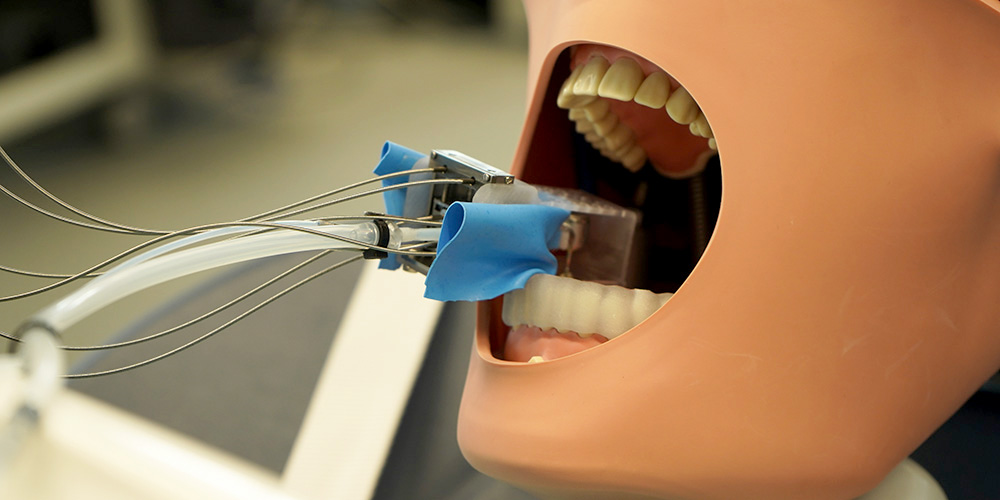
Photo: University of Basel, Catherine Weyer
A Compact Marvel: The Design of MIR
The prototype of this innovative dental robot is no larger than a wine cork, measuring 43 by 26 by 28 millimeters. Its compact design is purposeful, allowing it to fit comfortably in the confined space of an open mouth. “It is designed to be small enough to fit comfortably into an open mouth,” explains Dr. Yukiko Tomooka, the first author of the research paper published in IEEE Transactions on Medical Robotics and Bionics. This engineering marvel incorporates motors and a control system located externally, connected to the robot via flexible drive shafts, cables, and tubes.
Revolutionizing Appointments
Currently, the process of preparing a tooth for a crown involves multiple appointments, but that could change dramatically with MIR. The robot is programmed to prepare teeth with remarkable precision according to a digital treatment plan. After an initial scan during the patient’s first appointment, dentists can plan the exact removal of tooth material needed and even order the permanent crown immediately, rather than waiting weeks.
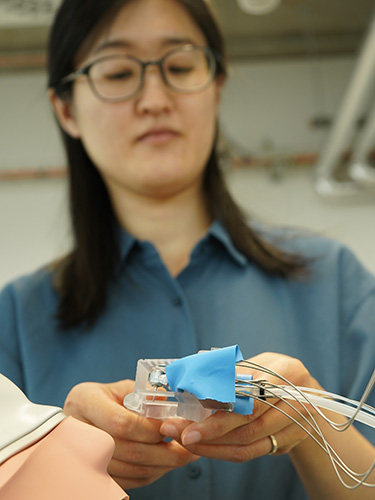
Photo: University of Basel, Catherine Weyer
Precision Redefined
MIR has undergone rigorous testing on tooth models made of synthetic resin and ceramic materials, simulating the hardness of real tooth enamel. The operational mechanics of the robot involve a two-step process for tooth preparation. In the first step, a wide drill reduces the surface area from above, while a longer, thinner drill carefully shapes the sides of the tooth.
What’s astonishing is the accuracy with which MIR operates; current testing has shown positional errors lower than 0.2 millimeters. Although the robot is still in development and lacks direct sensors for position measurement, the promise of future iterations that will include such technology could further refine this precision.
Managing Forces and Sound Levels
In the quest for dental excellence, researchers also focus on the forces generated during the drilling process. During their tests, the force remained below five newtons—the equivalent of the gravitational pull on a half-liter bottle of water. This ensures not only effectiveness but also comfort for the patient. Understanding noise levels produced by MIR is another critical factor, as an overly loud machine could detract from the patient experience in a dental practice.
Future Improvements: Sensory Technology
Further advancements are necessary before MIR can be integrated into everyday dental practice. The next steps will involve adding sensors and a camera to the robot. This enhancement would allow the system to monitor its position and track treatment progress in real time. Dr. Georg Rauter, the research group leader, explains that this sensor data would enable MIR to continue its work even after a power outage, ensuring that it can always resume precisely where it left off—an incredible feature for patient care.
Collaborative Efforts in Development
The journey to bringing MIR to the dental chair is not a solo venture. This innovative project has emerged from a collaborative effort involving experts from various institutions, including the University of Zurich and Camlog Biotechnologies GmbH in Basel. Supported by Innosuisse funding, the project aims to bridge the gap between academic research and practical medical applications—a crucial step in bringing robotic technology into everyday healthcare.
The vision behind MIR is not just about creating a mechanical assistant; it’s about enhancing patient care, reducing time spent in the dental office, and improving overall outcomes. This little robot has the potential to change the landscape of dental procedures as we know it.
Discover more about this cutting-edge technology and its implications by reading the full research article: Miniature Intraoral Robot (MIR) for Minimally Invasive Tooth Preparation.