
TL;DR: AI ethics involves the rules people follow when building and using AI systems. The idea is to keep AI decisions fair, easy to understand, and clearly accountable. It also looks at problems such as biased results and the misuse of personal data.
What is AI Ethics?
AI ethics is a field that examines the fundamental rules and values that govern the creation and application of artificial intelligence. Professionals in this area scrutinize how AI systems make decisions and the broader implications these decisions have on society. Central questions include concerns over bias in training data, the clarity of AI results, the safeguarding of personal data, and the assignment of responsibility when automated systems make errors. At its core, AI ethics seeks to ensure that artificial intelligence treats individuals fairly, remains transparent, and complies with human and legal standards.
5 Key Principles of AI Ethics Explained
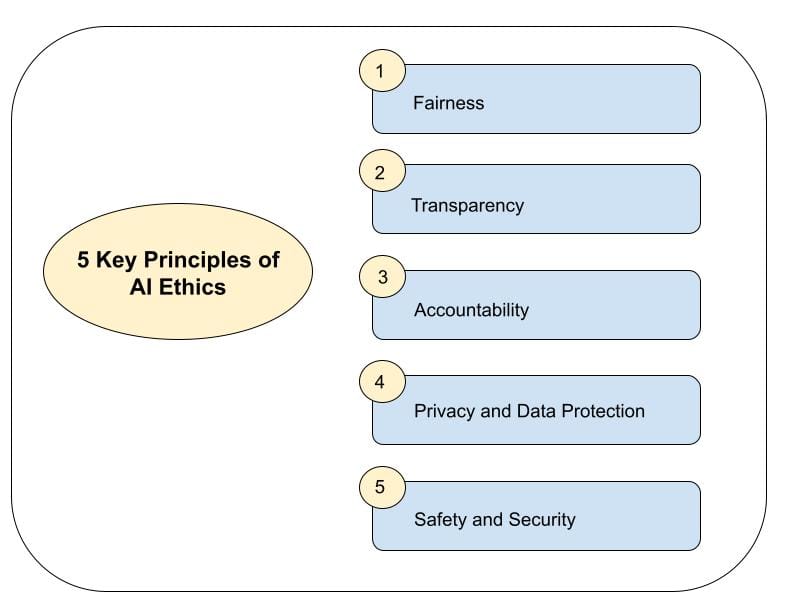
The framework of AI ethics is anchored by five core principles that guide the design and usage of artificial intelligence systems:
1. Fairness
Fairness is the principle that AI should not treat individuals unevenly or unjustly. Many AI models are trained on historical data, which may contain biases that perpetuate inequality in their outputs. Developers are tasked with scrutinizing their datasets and analyzing how models perform across diverse user groups. When they identify biases, adjustments are essential to ensure equitable outcomes for all.
2. Transparency
Transparency involves making AI systems’ decision-making processes clear and accessible. Users should understand the factors that influenced an AI’s output. To facilitate this, developers create comprehensive documentation, implement tools to elucidate model outputs, and inform users when AI is involved in decision-making. Such openness allows for greater scrutiny and assurance of proper functioning.
3. Accountability
Accountability refers to the necessity of designating someone responsible for the actions of an AI system. Even if algorithms operate autonomously, the individuals and teams that create and maintain them should monitor their conduct and intervene when issues arise. Effective AI governance elaborates on who supervises the system and evaluates decisions when complications emerge.
4. Privacy and Data Protection
Given the heavy reliance on user data in AI operations, protecting this information is paramount. Organizations must secure the data they gather, restrict access only to what is necessary, and provide users with knowledge about how their data is utilized. Users should also have the ability to control their own information. A striking statistic reveals that six-in-ten AI experts express significant concern about potential misuse of AI-driven data. (Source: Pew Research Center)
5. Safety and Security
Safety in AI emphasizes ensuring that systems do not cause harm or generate negative consequences. Before deploying an AI model in a real-world context, thorough testing and ongoing monitoring of performance are crucial. Developers also need to fortify their systems against misuse or attacks, minimizing the potential for erroneous decisions, tampering, or unauthorized access.
Why AI Ethics Matters in 2026 Business and Society
In 2026, the comprehension of AI ethics and the ethical rules guiding AI systems has taken center stage in both business and society. Several key reasons underscore this significance:
-
AI Systems Now Influence Critical Decisions
AI technologies are no longer confined to experimentation; they play a pivotal role in numerous decisions, from credit assessments and job application screenings to medical recommendations and fraud detection. Mistakes or biases in these algorithms can significantly impact people’s financial security, health, and employability. Adhering to AI ethics means rigorously testing and reviewing these systems to avert real-world repercussions.
-
Governments Are Introducing AI Regulations
The landscape of AI regulation has changed dramatically in recent years. Laws such as the European Union’s AI Act mandate that companies document their models, assess associated risks, and ensure transparency for high-risk applications. Non-compliance can lead to hefty fines and operational limitations, making adherence to AI ethics frameworks essential for many organizations.
-
Trust in AI Depends on Transparency
Public trust in AI technologies hinges on comprehensibility in decision-making processes. A lack of clarity can breed skepticism, especially when AI impact critical facets of life such as employment, finance, and personal services. By demonstrating transparency in decision-making and maintaining clear records, organizations can bolster user confidence and uphold their credibility.
-
Ethical Design Reduces Bias and Social Harm
Machine learning is fundamentally about recognizing patterns in data. Should this data be biased or not represent a comprehensive spectrum, the resulting models risk propagating these errors. This underscores the necessity for scrutinizing training data and monitoring potential biases. Early detection and remediation can avert discriminatory outcomes and prevent significant complications for companies.
-
Responsible AI Supports Long-Term Innovation
Embracing AI ethics frameworks does not hinder innovation; rather, it guides organizations towards developing effective and problem-free AI solutions in the future. By addressing issues like bias, security vulnerabilities, and potential misuse proactively, businesses can harness AI responsibly across various sectors while avoiding crises that diminish public trust.
Real-World AI Ethics Examples and Use Cases
AI ethics plays out across various applications today. Below are illustrative examples demonstrating how these principles guide decision-making within AI systems:
-
Hiring and Recruitment Algorithms
Increasingly, companies employ AI to analyze resumes and streamline candidate selection. These algorithms evaluate qualifications, education, and experience to rank applicants. However, if their training incorporates biased past hiring practices, the AI may inadvertently perpetuate those biases.
To mitigate this risk, organizations can regularly audit their systems, anonymize sensitive demographic information, and foster transparency to ensure fair hiring practices.
-
Healthcare Decision Support Systems
Hospitals utilize AI tools to assist medical professionals in diagnosing patients, from interpreting medical images to identifying patterns in patient data that might otherwise go unnoticed. Nevertheless, accuracy is paramount, and physicians need to verify AI recommendations while also ensuring patient confidentiality.
-
Facial Recognition in Public Security
Facial recognition technology is deployed in settings like airports and public transport as well as by security forces to identify individuals. However, it raises serious privacy issues and can exhibit unequal accuracy for different demographics.
In response, governments have established guidelines that govern its application, focusing on fairness, precision, and the ethical use of such technology.
-
Credit Scoring and Loan Approval
Banks implement AI to streamline loan decisions based on factors like financial history and spending behavior. However, these algorithms may inadvertently favor certain demographics over others, prompting regulators to require transparency and justification for lending outcomes.
-
Content Recommendation on Digital Platforms
Platforms such as social media and streaming services harness AI for content recommendations that align with user interests. While this can enhance engagement, it may also propagate misinformation or encourage excessive consumption. Leading platforms actively work to monitor their AI systems for accuracy and transparency.
Learn 29+ in-demand AI and machine learning skills and tools, including Generative AI, Agentic AI, Prompt Engineering, Conversational AI, ML Model Evaluation and Validation, and Machine Learning Algorithms with our Professional Certificate in AI and Machine Learning.
Top AI Ethics Frameworks and Regulations
Having delved into the fundamentals of AI ethics, its key principles, and relevant use cases, it’s crucial to examine some significant frameworks and regulations:
-
EU Artificial Intelligence Act (EU AI Act)
The EU AI Act, enacted in 2024, represents one of the first comprehensive pieces of legislation tailored to regulate artificial intelligence. Its risk-based approach mandates that high-risk applications—such as those in healthcare, recruitment, and law enforcement—adhere to stringent standards regarding data integrity, transparency, documentation, and human oversight. The regulation enforces legal obligations for organizations delivering or utilizing AI across the European Union.
-
OECD AI Principles
The OECD AI Principles provide global guidance aimed at developing trustworthy AI systems. They encourage entities to craft AI technologies that uphold human rights, remain transparent, and operate under safety protocols. More than 40 nations have adopted these principles, shaping national AI strategies and international governance frameworks.
-
UNESCO Recommendation on the Ethics of AI
The UNESCO Recommendation on the Ethics of Artificial Intelligence, adopted in 2021, emphasizes safeguarding human rights and social values in AI deployment. It advises governments to formulate policies rooted in fairness, privacy, accountability, sustainability, and human oversight while advocating for ethical impact assessments prior to rolling out large-scale AI systems.
-
NIST AI Risk Management Framework (AI RMF)
Established in 2023, the NIST AI RMF provides actionable guidance for organizations designing or deploying AI solutions. It focuses on identifying and managing risks throughout the AI lifecycle by organizing governance around four primary functions: govern, map, measure, and manage. These steps assist organizations in evaluating risks, monitoring performance, and applying remedial strategies when challenges arise.
-
Council of Europe Framework Convention on AI
Adopted in 2024, the Framework Convention on Artificial Intelligence functions as an international treaty designed to ensure AI systems respect human rights, uphold democratic values, and follow the rule of law. It incorporates principles such as transparency, accountability, and non-discrimination, mandating impact assessments and oversight mechanisms to mitigate AI-related risks.
How to Implement Ethical AI in Organizations?
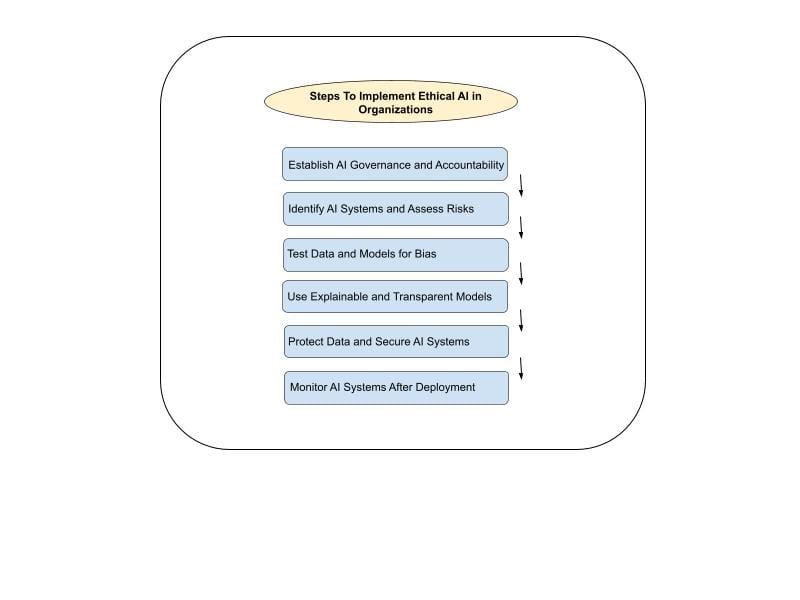
In addition to the aforementioned regulations and frameworks, organizations require practical steps to put ethical AI into practice:
-
Establish AI Governance and Accountability
The initial step is creating a governance framework for AI initiatives. Organizations should delineate roles for developers, data scientists, compliance teams, and leadership while formulating policies that describe AI systems’ design, testing, and monitoring protocols. Effective governance ensures clear accountability for AI-driven decisions and upholds ethical standards throughout the development cycle.
-
Identify AI Systems and Assess Risks
Documenting every AI system in operation within an organization is crucial. This inventory allows teams to discern which models impact significant decisions and the data they employ. Once identified, teams can conduct risk assessments, examining bias, privacy issues, and security vulnerabilities prior to deployment.
-
Test Data and Models for Bias
Ethical AI practices mandate routine testing of datasets and model outputs. Developers should track performance metrics across diverse demographic groups to identify and rectify bias. Employing bias detection tools and fairness metrics can enable early identification of issues, facilitating interventions such as data balancing or model adjustments.
Did You Know? McKinsey reports that 47% of organizations have experienced at least one adverse outcome from generative AI, with only 27% of them claiming they review all AI-generated content before use. This highlights a significant ethics gap in practice. (Source: McKinsey & Company)
-
Use Explainable and Transparent Models
Organizations must ensure that AI decisions are understandable and verifiable. Explainable AI techniques—like comprehensive documentation and interpretability tools—should be implemented to aid developers and regulators in grasping how decisions are made. Transparent systems simplify the auditing process and help identify potential errors.
-
Protect Data and Secure AI Systems
As AI systems often manage sensitive information, data protection becomes paramount. Organizations typically deploy encryption, access controls, and secure storage. Additionally, rigorous testing is essential to ensure the integrity of AI systems against manipulation or unauthorized alterations.
-
Monitor AI Systems After Deployment
The commitment to ethical AI continues throughout the lifecycle of a deployed model. Organizations must consistently monitor performance metrics to detect shifts in accuracy, bias, or security vulnerabilities. Conducting regular audits and reviews ensures that AI systems operate safely and efficiently as conditions evolve.
As AI technology advances, new ethical dilemmas will inevitably emerge. Technologies such as generative AI, deepfakes, and automated decision-making tools may introduce risks related to misinformation, privacy breaches, and potential misuse. Organizations should treat AI ethics as a continually evolving responsibility, updating their practices as the technology matures.
Key Takeaways
- AI ethics focuses on how AI systems should be designed and used, ensuring automated decisions are fair, transparent, accountable, that user data is protected, and legal rules are adhered to.
- Ethical AI is typically built around five main principles: fairness, transparency, accountability, privacy and data protection, safety.
- AI ethics challenges present in various real-world applications include hiring software, healthcare decision support tools, facial recognition systems, credit-scoring models, and recommendation platforms.
- To implement AI ethics effectively, organizations should focus on governance structures, testing for bias, employing explainable algorithms, safeguarding sensitive data, and conducting ongoing monitoring post-deployment.
FAQs
1. What are the 5 pillars of ethical AI?
The primary principles include fairness, transparency, privacy, security, and accountability. Essentially, this means ensuring that AI treats all individuals fairly, provides clear explanations for decisions, keeps personal data safeguarded, and establishes accountability for its outcomes.
2. Why is AI ethics important for businesses?
AI ethics plays a crucial role in helping businesses avoid biased outcomes and safeguarding user data. Moreover, it enhances organizational trustworthiness, particularly when AI influences important decisions.
3. What is fairness in AI ethics?
Fairness implies that AI systems should not yield discriminatory results. Developers are responsible for scrutinizing their datasets and models to confirm that predictions do not disadvantage individuals based on characteristics such as gender, ethnicity, or age.
4. What role does transparency play in AI?
Transparency enables users to grasp how AI systems reach their conclusions. Clear documentation, explainable models, and disclosure of AI involvement help users and regulators analyze the reliability of the system.
5. How to ensure accountability in AI systems?
Establishing accountability involves designating responsibility for monitoring AI usage. Organizations must track how AI systems perform, evaluate their efficacy, and ensure the correct individuals oversee their development and application.
6. What regulations govern AI ethics in 2026?
Key regulatory frameworks that guide ethical AI use include the EU Artificial Intelligence Act, OECD AI Principles, UNESCO’s AI ethics recommendation, and the NIST AI Risk Management Framework. These guidelines assist developers in adopting responsible methods, managing risks, and enhancing system transparency.
7. What are the risks of ignoring AI ethics?
Neglecting AI ethics risks leading to biased decision-making, breaches of privacy, security vulnerabilities, and eroded public trust. Organizations that fail to comply with ethical standards may face legal repercussions or regulatory constraints should their AI systems cause harm or violate data protection laws.